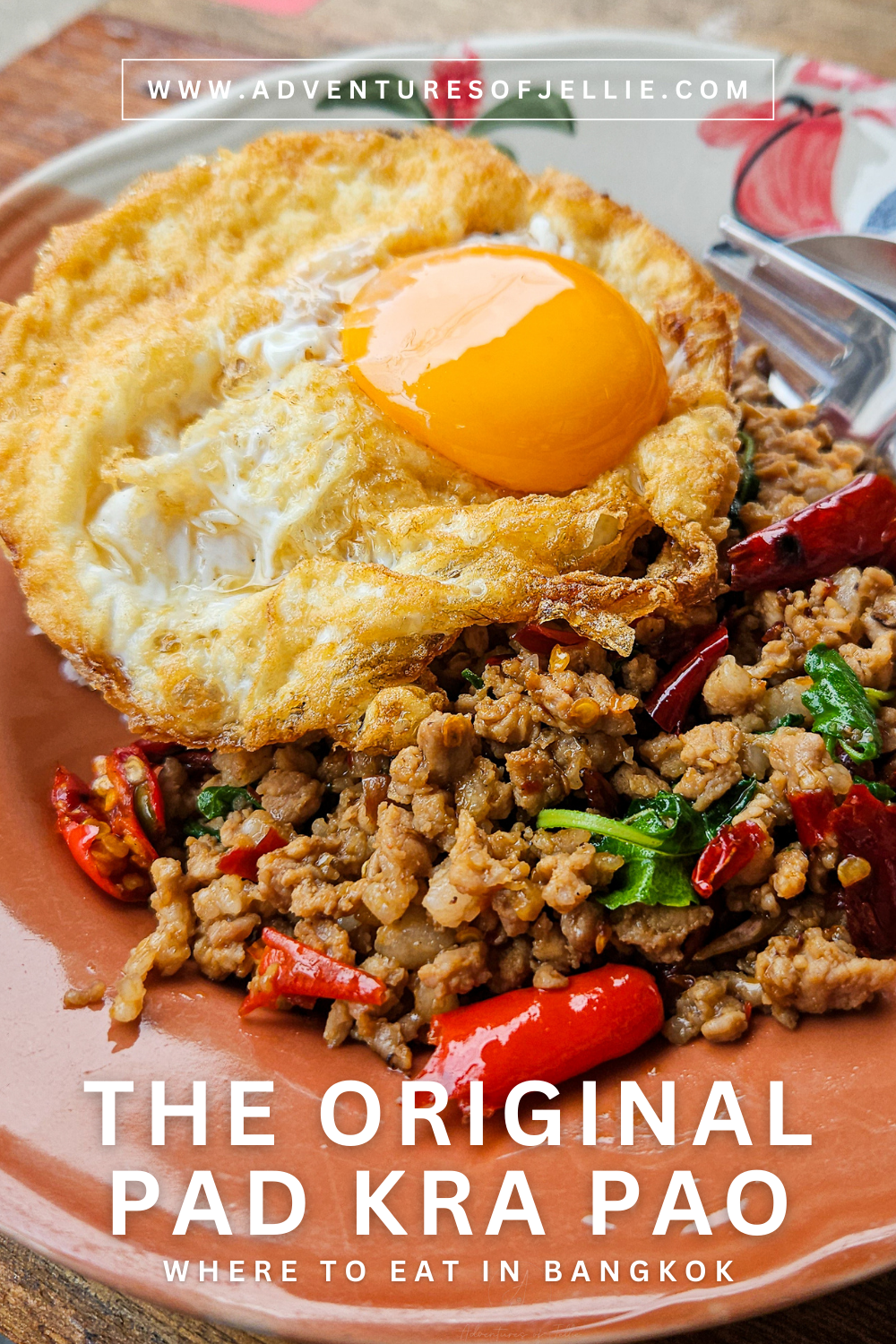
The Original Pad Kra Pao, Bangkok
If you have spent any time in Thailand you cannot have avoided pad kra pao. The dish is on every Thai menu, every market serves it and every other street-stall’s wok sizzles with its fiery flavours. From north to south, the heady, spicy mix of Thai holy basil, chilli and minced meat perfumes food courts and night markets. Honestly it seems more popular than the internationally famous pad thai, it is practically the national dish!
Originally an adaptation of immigrant Chinese stir fry dishes, pad kra pao was soon enjoyed and adopted by local Thais. It was absorbed into the Thai food scene, transmuted with local flavours and ignited with Thai cuisine's signature spiciness, quickly becoming the quintessential Thai one-wok dish. It is not an ancient recipe, first popping up in the early 20th century but its quick preparation, powerful flavour and ubiquitous ingredients have made it an instant Thai classic.
Given all of the above we approached the "Original Pad Kra Pao" restaurant with some scepticism. How could it make such a claim? How “original” could it be? Was it just a lure for gullible travellers like us? Was it, at the end of the day, any good?!
Disclosure: This article may contain affiliate links. We will earn a small commission from any purchases made through these links.
What is pad kra pao?
Pad kra pao, pad kaprow, pad kra pow, gaprow, kaphrao or a dozen other possible spellings, all refer to the Thai street food staple กะเพรา. Literally translated - rice (pad) and holy basil (kra pao).
Pad kra pao is a dish of either meat, vegetables, seafood or tofu, stir fried in a wok with Thai holy basil and chilli then served over rice. The defining flavour of the dish is the holy basil that gives a delicious iron-y/herby tone to each bite, it is balanced with soy, fish and (sometimes) oyster sauce. The whole dish is then set ablaze with bird’s eye (Thai call them mouse penis!) chilli's. The flavours are, like lots of Thai cooking, perfectly balanced between salty, sweet, sharp and spicy.
For the complete experience make sure you get it topped with a thai fried egg - just ask for "khai dao" (sometimes it can be pronounced key dao)!
Where is the Original Pad Kra Pao restaurant?
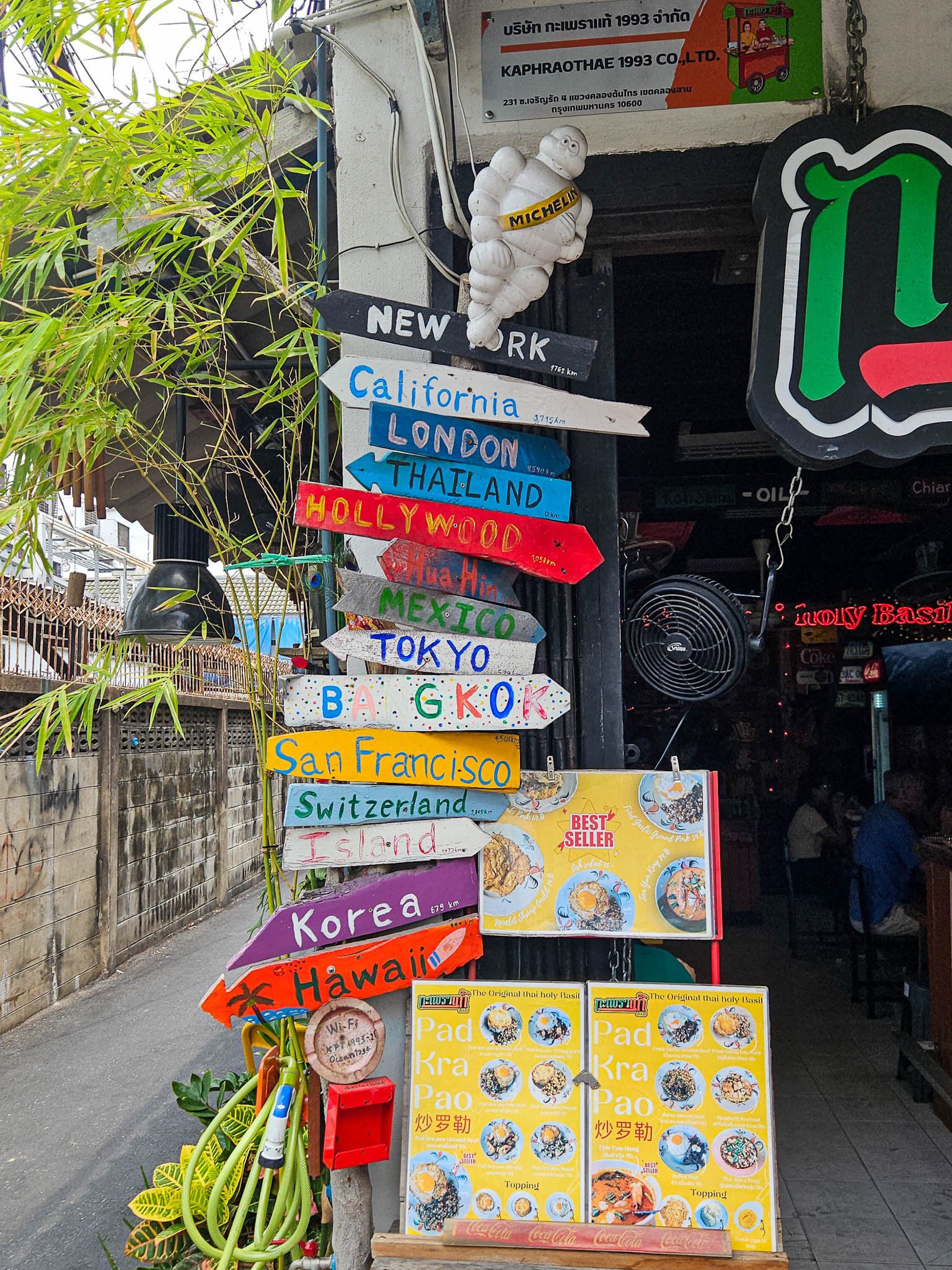
The restaurant that serves what it claims to be the original recipe sits on a humble sidestreet near the Wongwian Yai Station (you can find it here) on the Western side of the Chao Phraya River in Thailand's bustling capital - Bangkok. The restaurant is located on a small side street just off the main Krung Thon Buri road. You can find it on a map here.
Is the Original Pad Kra Pao restaurant good? Is it worth the journey?
Is it good? Yes, it is very, very, very good! Pad kra pao is always a reliable Thai street food staple but this place has refined the dish into the very essence of what makes a pad kra pao sing.
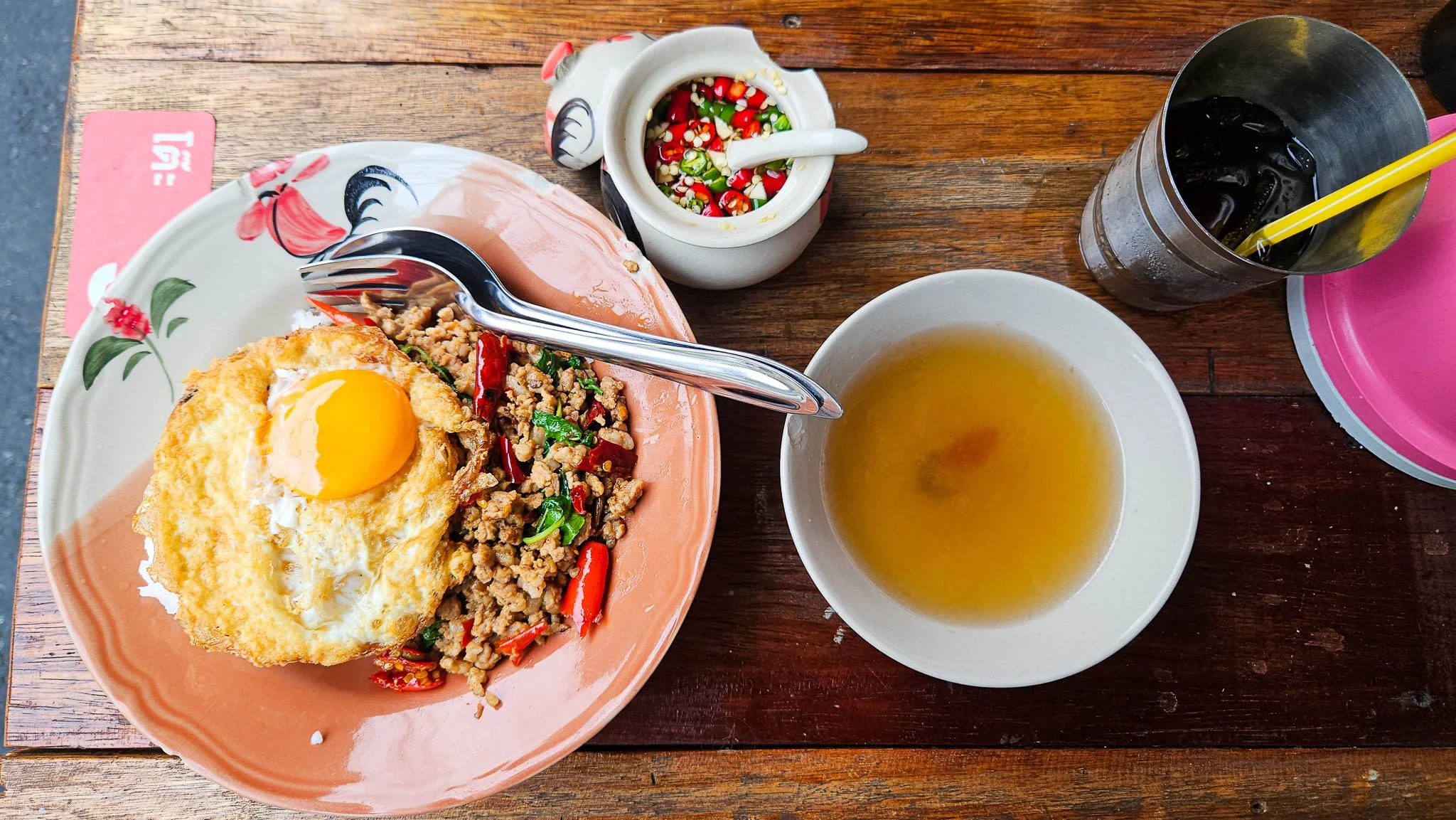
We both went for the classic, pad kra pao moo, kai dao - pad kra pao with miced pork and a fried egg. The pork was perfectly cooked; caramelised and very slightly sweet from the rendered fats but with a tang and complex savouriness from fish sauce. The holy basil was amazing; a heady, fragrant perfume that underscored every bite. Holy basil is a little like liquorice but deeper, irony and well... better. Neither of us like the taste of liquorice but both of us love the taste of holy basil! We have been travelling Thailand a while now and are accustomed to and love spicy food so asked for our plates to be "phed" (hot/spicy - pronounced like the "ped" from "moped"). The lovely woman who took our order asked us if we were sure we wanted spicy, and we can see why:
There are ranges of "phed" in Thailand:
Mai Phed (pronounced roughly ‘my ped’) - not spicy, ask for this if you really cannot tolerate chilli in any form.
Tourist restaurant "phed" - may once have been briefly shown a picture of a chilli, little to no actual heat.
Regular local restaurant "phed" - actually spicy, do not give to Grandma (unless Grandma is Thai!)
Issan "phed" / Thai "phed" - strap in, you are in for a ride! Once you are used to it (it takes a while!) this is the best and tastiest level of spice. Thailand uses chillies to add flavor as well as heat, so many dishes lose their sparkle if you neuter their spice. Chilli in Thailand is not about bravado, it is really a treasured flavour.
This time "phed" meant "phed", I'm sure if our Thai was better or we were locals it would have been spicier but there was definitely plenty of chilli! The heat permeated every part of the dish with slivers of ruby red bird's eye chillies peppering the plate and adding electricity to every mouthful. Some dishes require the punch of chilli, pad kra pao is 100% one of them and the Original Pad Kra Pao restaurant did not disappoint.
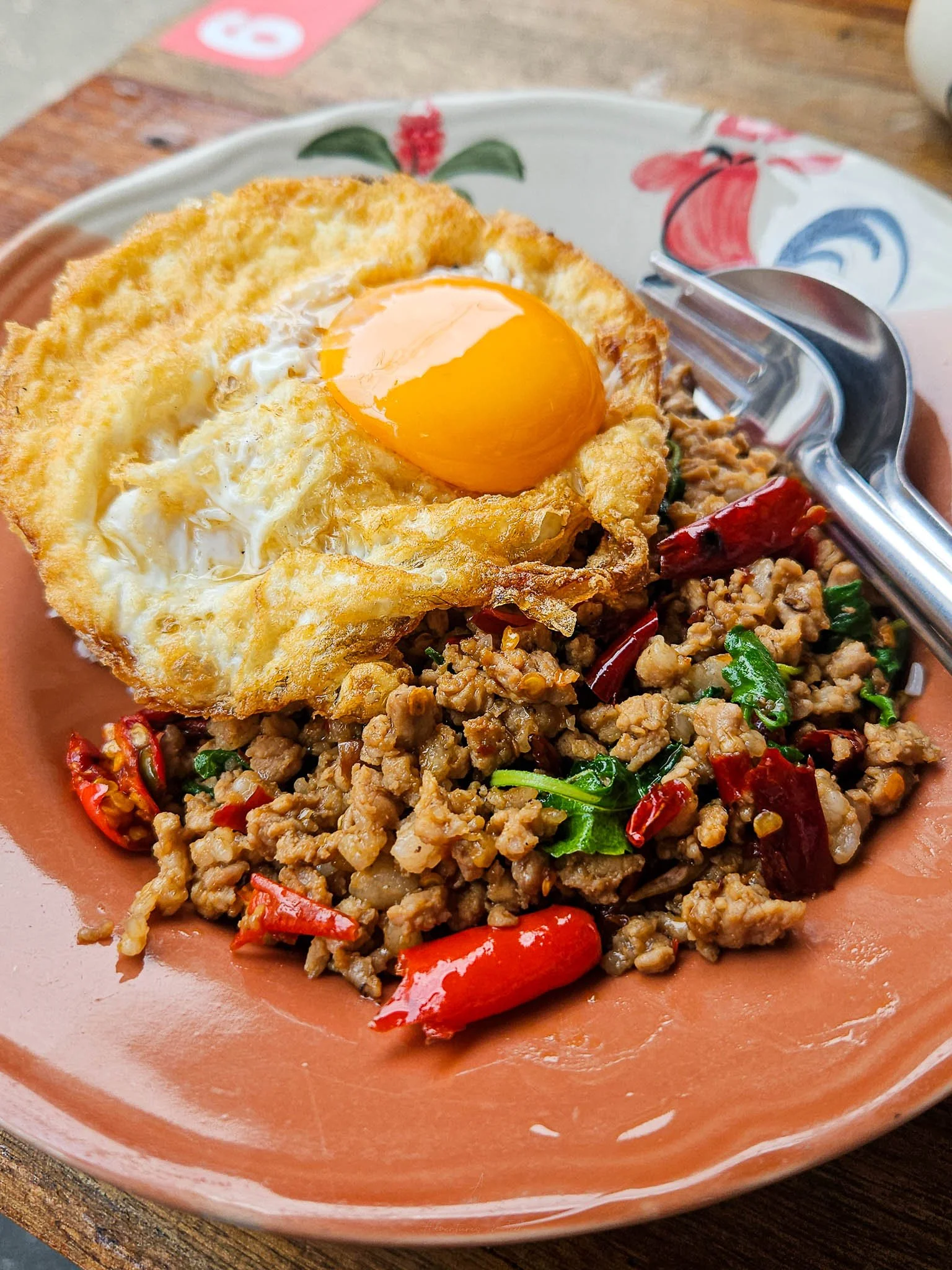
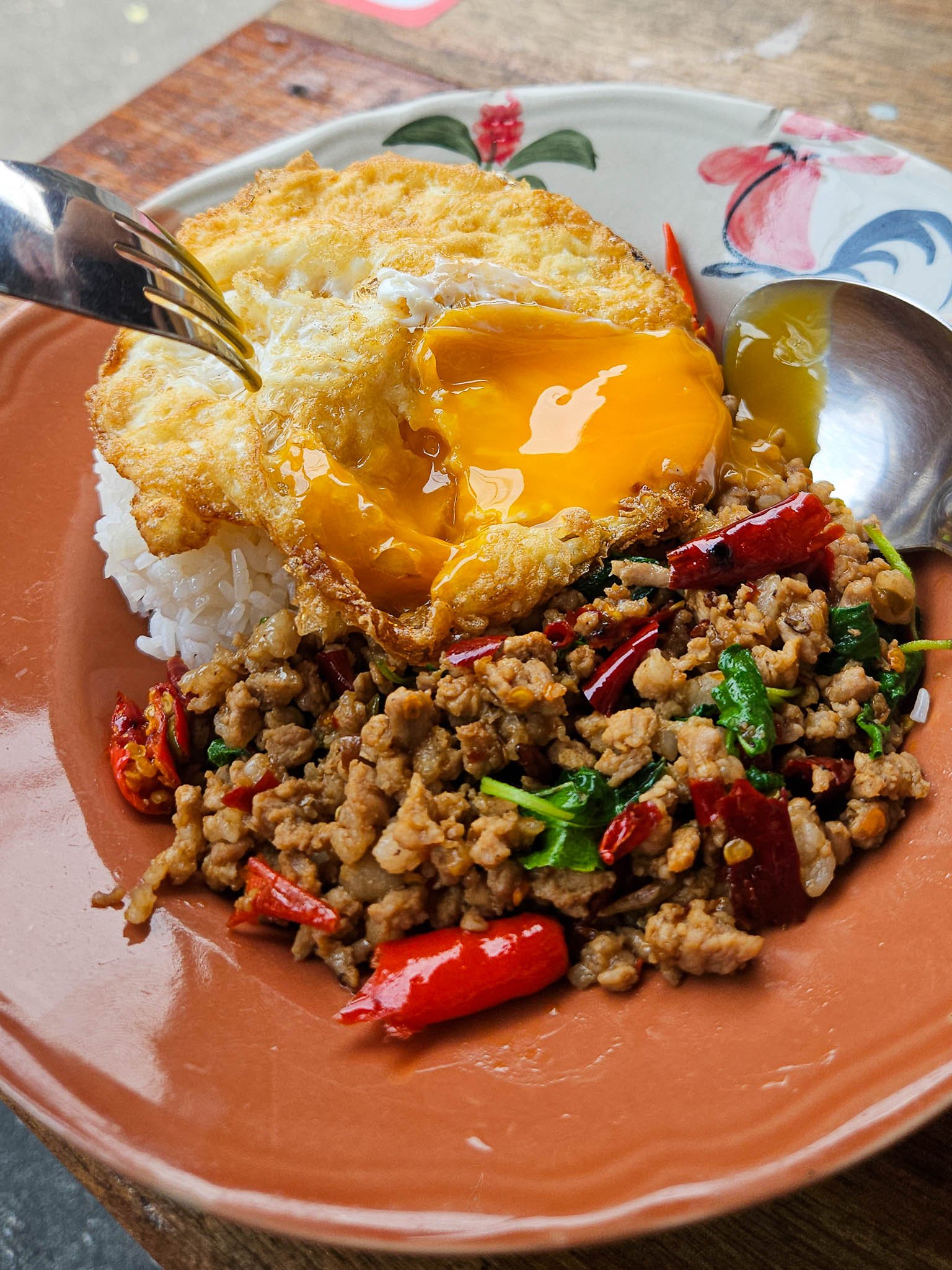
Crowning the whole dish was a fried egg. For those of you who have not had the pleasure of a Thai-style fried egg, you are missing out! To make a Thai style fried egg, the egg is cracked through a slotted spoon into sizzling hot oil, only the white part drips through the spoon’s slots and instantly bubbles and crisps up in the oil. Right near the end the yolk is placed back in the middle of the crispy edged egg white just to firm up and warm through. The result - the crispiest, most delicious egg white surrounding a perfect, runny, deep orange egg yolk. This works amazingly with pad kra pao as the runny egg coats the rice adding richness and rounding off the chilli. If you find any Thai 'over rice' dish too strong or fierce, try it again with an egg blanket - just ask for "kai dao". The eggs served at "The Original Pad Kra Pao" were phenomenal, the perfect addition and complement to the powerful flavours of the dish. The menu has several different styles of egg you can order, we recommend the “Thai style”, although there is one that is crispier still, the “special” let us know in the comments if you try this one as we were intrigued!
To complement everything the dish came with a small bowl of broth, it really is amazing what soup can do. The broth tied everything together and added another delicious element to the meal, its clean smooth flavor acting as a break from the full-on intensity of the pad kra pao.
On the table we had the traditional Thai cruet. Pad kra pao is a strong flavour but, everyone has their preferences with spice and sweetness and the cruet allows on-the-fly customisation of the dish. As delicious as the ‘naked’ pad kra pao was, we decided to switch it up halfway through; we added chilli fish sauce to our eggs and meat giving the sharpness and spicy savoury flavors a boost. If you wanted to emphasise the rich sweetness, you could have added the sugar or, for a more smokey heat, the deep red smoked chilli flakes.
The nutty fluffy rice, coated in rich egg yolk and laced with spicy, savoury, sweet and perfumed kra pao was amazing; the meal was fantastic, a brilliant example of what might be the perfect one-wok dish.
How 'original' is the "Original Pad Kra Pao”?
Simple but disappointing answer: We just do not know!
The restaurant’s name states it is from 1993 but pad kra pao has far earlier roots. The “Original” in the restaurant's name might be referring to the recipe itself. Early incarnations of the dish had simple recipes using nothing but meat, chilli, fish sauce, garlic and holy basil whereas modern versions of pad kra pao can have green beans, oyster sauce, sugar, onions and even sweetcorn.
We do not have advanced enough palates to tell you if the recipe used by the “Original Pad Kra Pao” featured oyster sauce but we can say that it was definitely of the ‘old school’ style. It was less sweet than some of the street food versions we have had, and its plates were simple and unadorned; there were no green beans in this pad kra pao, only meat, garlic, holy basil and chilli. It really felt like the simple, clear and clean flavours of the pad kra pao were given centre stage and allowed to shine.
There are modern flourishes to the menu, the Original Pad Kra Pao certainly offers more options than would have been available to the original street hawkers (we are pretty sure the original didn't always offer spaghetti or seafood!), but this doesn't make its dishes any less tasty or 'authentic' (we really hate the way the word 'authentic' is used with food, but that is a story for another time).
The restaurant itself is kitsch and charming, its shophouse style interior is entirely decked out in colorful vintage posters (included old Titanic film posters for some reason), street signs, buckets of sliced chillies and crates of fresh eggs. Blazing neons declare it the “Original thai holy Basil” (including the odd capitalisation) and strings of fairy lights crisscross the room. The seating spills out onto the little road outside, with tables clinging to the slide of the building. It is, like lots of Bangkok shophouses, cute, friendly and inviting.
Is pad kra pao the only thing they serve? What if I don’t eat meat?
Obviously, the Original Pad Kra Pao restaurant specializes in its namesake dish but it is not the only thing on the menu. If you are going with friends but do not like / want a pad kra pao yourself, you won’t starve! There was tom yum soup on the menu as well as a couple of fried noodle dishes, fried rice dishes and some other Thai staples. We cannot comment on how good any of the non-kra pao dishes are, but the rest of the food is so good it would be surprising if they were not equally yummy.
If you are a vegetarian / pescatarian there are options that may accommodate you. The menu has shrimp kra pao as well as squid kra pao. You certainly do not have to have the fried egg (just ask them not to give you one). There was (surprisingly) no tofu centered option on the menu, you could possibly ask for this but it is not (or certainly was not) a menu item.
When we visited they were not advertising any specifically vegan friendly options, as the dishes nearly always will use fish sauce this would be an issue with a vegan kra pao. The menu specifically states that they use the same house-made kra pao sauce for all dishes so it is unlikely that a true vegan option is available.
I cannot handle my spice, can I still eat at the Original Pad Kra Pao restaurant?
Absolutely! As we’ve mentioned above, when you place your order at the restaurant you choose your spice level. For those not keen on spice you can choose to have the Level 0 ‘no chilli' option or for those daring enough (or stupid enough to feel the burn), you can test your taste buds and pick Level 5, the ‘Spicy Spicy’ option! We are both good with our spice and decided to play it safe (Thailand doesn’t mess with it’s spice) and both opted for Level 4 ‘spicy’ which was absolutely perfect! A big kick of heat with every mouthful, but not too much so that we could enjoy every bite!
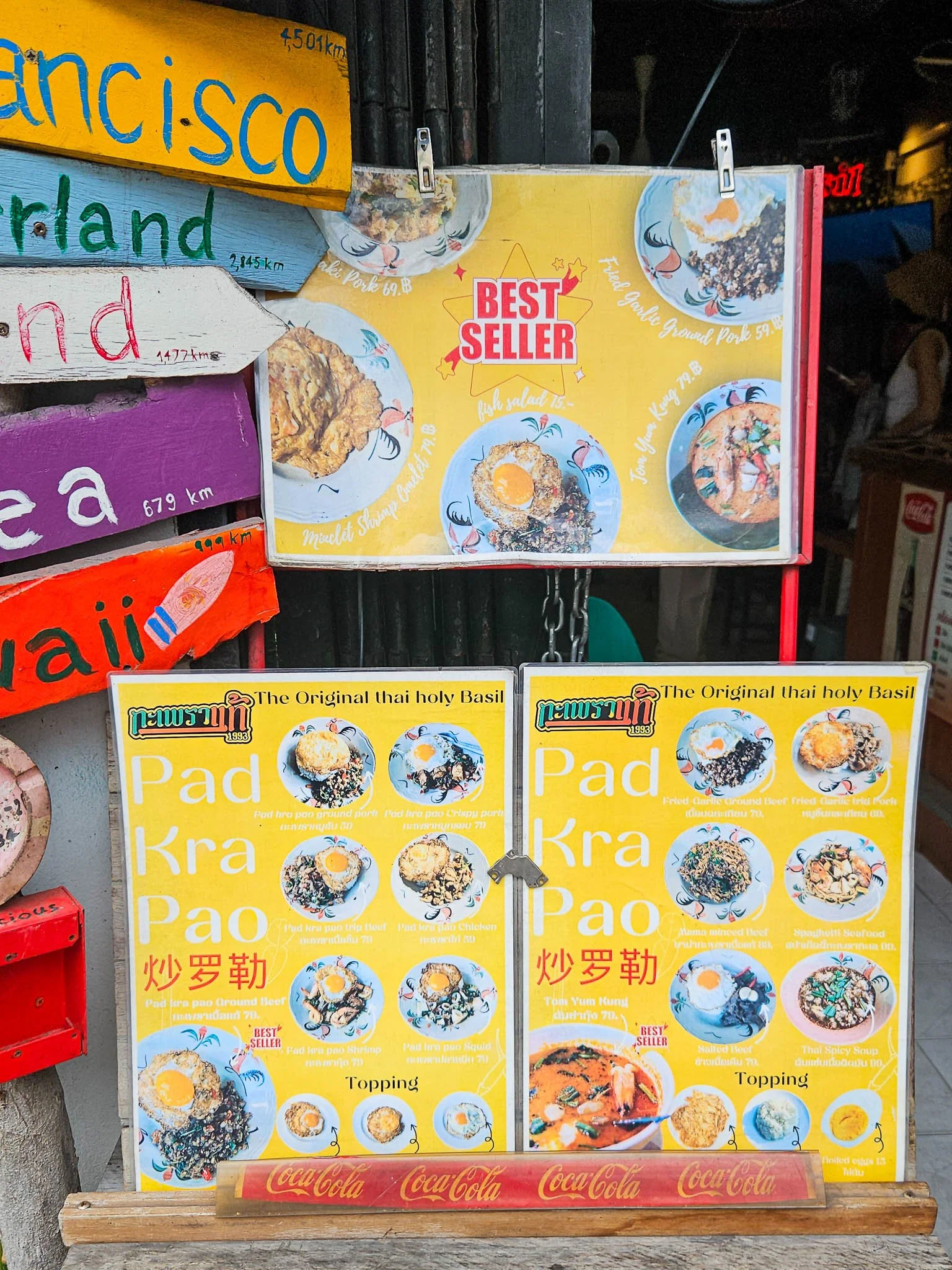
How much is a meal at the Original Pad Kra Pao restaurant?
A plate of pad kra pao costs 89 baht, with fried eggs costing an extra 10 baht. The price is a little more than you would pay at a street food stall in the city, but seeing as you’re sat in a restaurant, with service it’s really not bad!
The Original Pad Kra Pao also serves a selection of Thai iced style teas and coffee as well as soft drinks.
How to get to the Original Pad Kra Pao restaurant?
You can find the restaurant here on Google Maps
The simplest way to get anywhere in Bangkok is by taxi. You can hail one from the street (make sure to insist on a meter!), or use a ride hailing app like Grab or Bolt. You can get car taxi’s, scooter taxi’s or even go by tuktuk for the full tourist experience (you have to do it at least once!). Scooters will be cheapest (make sure to insist on a helmet) and tuk-tuk’s tend to be the most expensive. With any kind of motorized transport, beware of Bangkok’s legendary traffic!
If you’re after a reliable eSIM for data / Grab we can whole-heartedly recommend using Holafly - check out their Thai eSIM deals here.
For the more adventurous, or those watching their budget, the restaurant is easily accessible by public transport. The Original Pad Kra Pao restaurant is only a short walk from Wongwian BTS on the Dark Green (Silom) Line. There are also several bus routes that will take you near the restaurant from nearly anywhere in the city - use the ViaBus App to check what routes are near you. The bus will drop you off nearby and it will be a short wander through some interesting streets to the restaurant.
We are budget backpackers so we jumped on a bus from our lovely Old Town hostel (Lost Inn BKK). Even if you are not counting the pennies, it is always worth exploring Bangkok by bus or on foot. There is so much happening on the streets of the Thai capital; from tiny side-alley markets to old-school shophouses and fruit vendors, there is always something interesting to see.
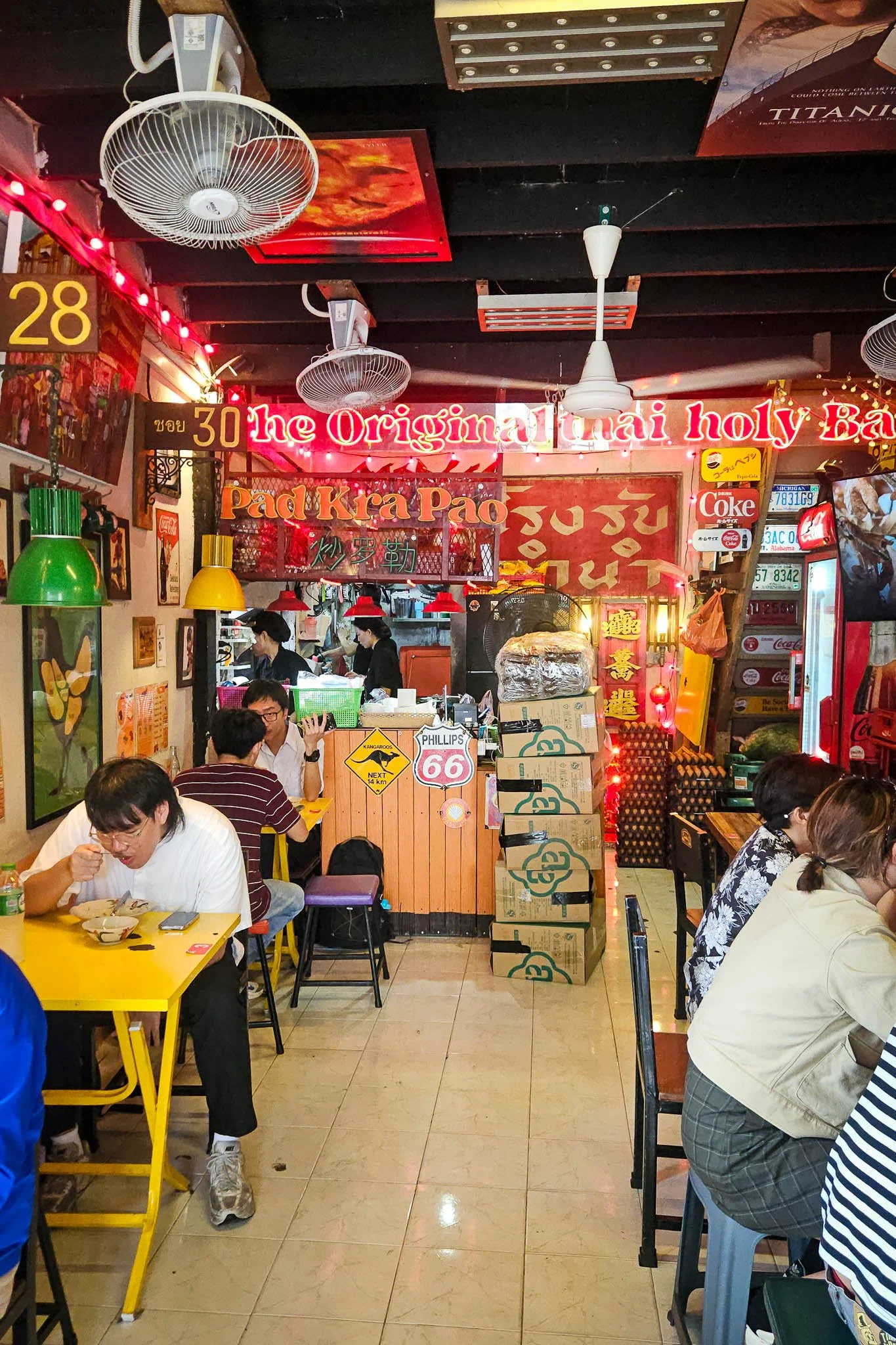
Opening times of the restaurant
The Original Pad Kra Pao is open everyday between 11 AM and 9 PM except for Wednesdays when they close for the day.
The restaurant can get very very busy at peak times (lunch and early dinner) so plan your visit accordingly. We had a late lunch around 2 PM and it was busy but we did not have to queue. That being said the service is fast and the turnover quite quick, if there is a queue you probably won’t have to wait too long.
If you ever need reassurance that somewhere in Bangkok is worth visiting, just look at where the Thai’s queue for lunch and which stall / restaurant is buzzing with food delivery drivers, it is always a good indication that there is something delicious to be found!
Final thoughts
Was it worth it? For us it is a definite yes, the Original Pad Kra Pao had given us an excuse to get on a bus and explore another area of Bangkok we had not really been to before and the restaurant itself was very cute, welcoming and, as mentioned, delicious.
We would say however, that if you have limited time in Bangkok and can't fit in a lunch at the restaurant, do not despair! We have had dozens if not hundreds of pad kra pao’s in Thailand and they are nearly always brilliant. Just head away from tourist restaurants, find a street vendor and you cannot go wrong ... well unless you forget the kai dao!
Thanks for reading,
John & Ellie x
#adventuresofjellie
All our Bangkok food guides
If you are interested in Thai food in Bangkok make sure you check out our articles on some of the amazing food tours and markets. Bangkok is one of the greatest food cities on the planet, make sure you make the most of it!


If you’re found this blog helpful, entertaining or you just fancy supporting us, please click the button below!
If you’ve enjoyed reading this article, why not save the pin below?