
If you are thinking of beaches in Cambodia you are almost certainly thinking of the islands of Koh Rong, however, there is another sandy contender. The beaches of Kep are only a short drive away from the popular backpacking town of Kampot. In the 1920s, Kep was a favourite seaside retreat for the ruling powers of the colonial French. Nowadays, the French mansions stand abandoned, but the town has seen a resurgence in local tourists and travellers eager to explore its beaches, national parks and perhaps most importantly for us, its amazing seafood!

Kep is an easy day trip from the backpacking and travel hub of Kampot. Legendary for its seafood market and a local blue swimmer crabs, visitors flock here to eat the delicious, affordable seafood. Kep has more than just tasty crustaceans to offer though, with beautiful national parks and, in the right season, swathes of white sand beaches.
We took a day trip out from Kampot to sample the best Kep has to offer. This is what we got up to!
In This Kep Travel Guide
Disclosure: This article may contain affiliate links. We will earn a small commission from any purchases made through these links.
Kep - A Quick Travel Overview
Where is Kep: Kep sits on Cambodia’s southwestern shoreline looking out onto the Gulf of Thailand. You can find Kep on a map here.
Best time to visit Kep: October to May (Kep’s dry season) for prime beach weather.
Distance from Kampot: Just over a 30 minute drive (around 25 KM) away.
Top Highlights: The Kep Crab Market, the National Park, Kep Beach and Koh Tonsay.
Kep - Our Day Trip From Kampot
Our day started at our fantastic hostel in Kampot, the brilliant Karma Traders (if you haven’t already, make sure you check out our article on why you should book a stay at Karma Traders Hostel). Over a delicious Cambodian-style breakfast of bai saight chrou (grilled pork and rice - make sure you try it in Cambodia, it’s delicious) we decided that today was the day to explore the coast down to Kep. After a rainy few days in the wet season, the clouds had parted and the sun was finally peaking through. We took this as our cue to get on our scooter, head to Kep town and seek out a seafood feast.
Kep is legendary for its seafood, especially the local blue swimmer crabs. We had seen the crab market of Kep all over YouTube and, being foodies, we knew we had to try it ourselves.

A basket of the famous ‘Blue Swimmer Crabs’ of Kep!
After breakfast, we jumped on our $5 a day scooter and headed out through Kampot’s hectic traffic. Quickly leaving town behind, we joined the main road between Kampot and Kep. The road was flanked on either side by rice paddies, traditional wooden houses and the occasional water buffalo. The way itself was busy with local traffic - monks and children heading to schools and temples, all jostling for space with trucks and tractors.
The ride to Kep took just over half an hour. We turned off the main road and looped past the famous crab market. As we passed, we couldn’t help but feel a bit apprehensive, it looked so busy! Cars and scooters were crammed and jammed together and you could barely see the stalls through the throng of people. It wasn’t even lunchtime yet! We chose to be positive - this many locals couldn’t be wrong - it had to be good!
What To Do In Kep?
Kep has plenty to see and do, whether you are just visiting on a day trip from Kampot or are planning to spend a few days relaxing on the Cambodian coastline, there’s plenty to keep you occupied.
Relax on Kep Beach and see the Blue Crab Statue
📍Find Kep Beach on Google Maps here
We continued to scooter around the headland before pulling up at our first stop, Kep Beach. Despite the overcast day the beach was full of locals playing in the sand and dipping their toes in the water. We were travelling at the height of the wet season, so we were definitely not seeing the beach at its best, but this didn’t put a dampener on the families and Cambodian youth enjoying the surf.
All along the beachfront stretched market stalls offering food, drink, hammocks and picnic areas. The main strip of Kep Beach has a large car park behind it and plenty of beachside shops, restaurants and cafes. This is also where the majority of Kep’s hotels and resorts are.
The eastern end of the beach has the famous Kep ‘White Lady’ statue which stares out to sea. The story behind the statue is that a loyal wife of a local fisherman refused to eat or sleep until her husband came back from the sea…. the story does not have a happy ending … the husband never returned.
After our walk along the beach we couldn’t help but think about the last time we were here. Nine years previously, a fresh faced Jellie first set foot in southeast Asia and Cambodia was the first country we explored.
Kep back then was a very sleepy beach town. The road along the beach was single lane and the beach was shielded by massive trees. When we visited back then in the peak of the high season, the beach was quiet with barely a soul to be seen. Fast forward nine years and we’re back at the main beach and it couldn’t be more different. Throngs of parasols and deckchairs spread out across the sands all filled with Cambodian families. The quiet road was now busy with cars and the tall trees replaced by short palms with large-scale development rising up behind them.

Kep Beach has changed a lot!
You always know coming back to a place that after such a long time, that it will have changed. Kep has certainly grown up and expanded as a holiday destination. We were seeing the beach on an overcast day, with a high tide on a weekend in the wet season. We can imagine it is a bit more picturesque in the dry season, although it may be even busier!
Back on the scooter, we drove away from the beach and down the coast. Our destination was Kep National Park but not before a quick stop at what might be Kep’s most famous statue.
Standing in the waves, with its pincers raised up, as if to fandango, is the famous ‘Blue Swimmer Crab Statue of Kep’. It’s only fitting for Kep to pay tribute to its most famous crustacean. Blue swimmer crab meat is legendary for its sweet rich flavour. A flavour we would definitely be sampling later in the day. Photos snapped, it was time to head inland towards the National Park.

The famous ‘Blue Swimmer Crab Statue’ of Kep!
For a good view out over the sandy shoreline of Kep Beach we would recommend pulling in for a quick stop at the Zipline Cafe (location) for a coffee break. Perched above the beach in amongst the forest, the Zip-line Cafe is exactly what it says on the tin: Half zip-line, half cafe. We only took part in the latter and had a quick iced Americano pick-me-up so cannot comment on whether the zip-lining experience is worth it. The coffee isn’t the best you’ll find in Cambodia, but it’s cheap ($1.50!) and comes with a good view!
Kep town
Unlike Kampot, Kep town has no real “centre”. The town of Kep sits scattered, in one long line all along its coastline with hotels, restaurants, the Crab Market and cafes all vying for front row seats on the beachfront. As a town, Kep is very spread out; from the Kep Crab Market to Kep Beach it is a 2 KM walk so bear this in mind when booking accommodation.
To the east of the Crab Market, past the Koh Tonsay Boat Terminal pier, there is a small built up area that is home to Kep’s main produce market as well a few homestays, some local restaurants and coffeeshops. This area is also home to the Virak Buntham Express Kep bus booking office, which runs buses from Kep to Phnom Penh, Siem Reap and Kampong Thom.
If you’re arriving into Kep by train from Phnom Penh, Kep’s Railway Station is located to the north of town around a 15 minute drive away from Kep Beach.
Spot abandoned mansions
As the road wound away from the sea, we started to pass abandoned mansions, houses and hotels. This is Kep’s other, less glorious, claim to fame. In the 1920’s, during the colonial period, Kep was a popular retreat for the ruling French. The mansions here were abandoned in the 1940s and some destroyed by the Khmer Rouge as ‘symbols of the elite’. Today, you’ll see their crumbling remains peeking out from the trees or huddled behind their old gated walls. These ruins used to be a haven for urban explorers but recently they seem to have been bought off and locked away. Several of the ruins looked like they had been, at least partially, restored.
There were also more modern ruins to see on our drive inland. All through the Kep hillsides are half finished new builds and abandoned construction sites. Presumably, these were pre-COVID tourism investments that never got to see the light of day. We love ruins and abandoned things but nevertheless they are a slightly sad sight.
Explore Kep National Park
📍Find Kep National Park on Google Maps here
Arriving at the entrance to Kep National Park (ticket office location) we pulled over at the ticket booth and bought our entrance tickets for $1 each. The friendly guards at the entrance told us it was an 8km walk or we could just drive our scooter through it. We’re not saying we’re lazy but…
Back on our scooter we slowly made our way into the park. The path was busy with pedestrians but only for the first hundred metres, where they all turned off for the amazing views at the Led Zep Cafe and Viewpoint. Not needing any more caffeine just yet, we continued on.
The concrete road reminded us of the ones you find on the southern Thai islands; narrow, but not so much that you couldn’t pass bikers going the other way. The road snaked through lush jungle, surrounding us on all sides with thick green foliage. Every so often there would be a break in the trees and we would be treated to sweeping views down over Kep and the surrounding coastline. We continued on up until we found the previous incarnation of the Led Zep Café, it had amazing views but the rotting wooden floorboards had definitely seen better days. We do not recommend testing out the old viewpoint!
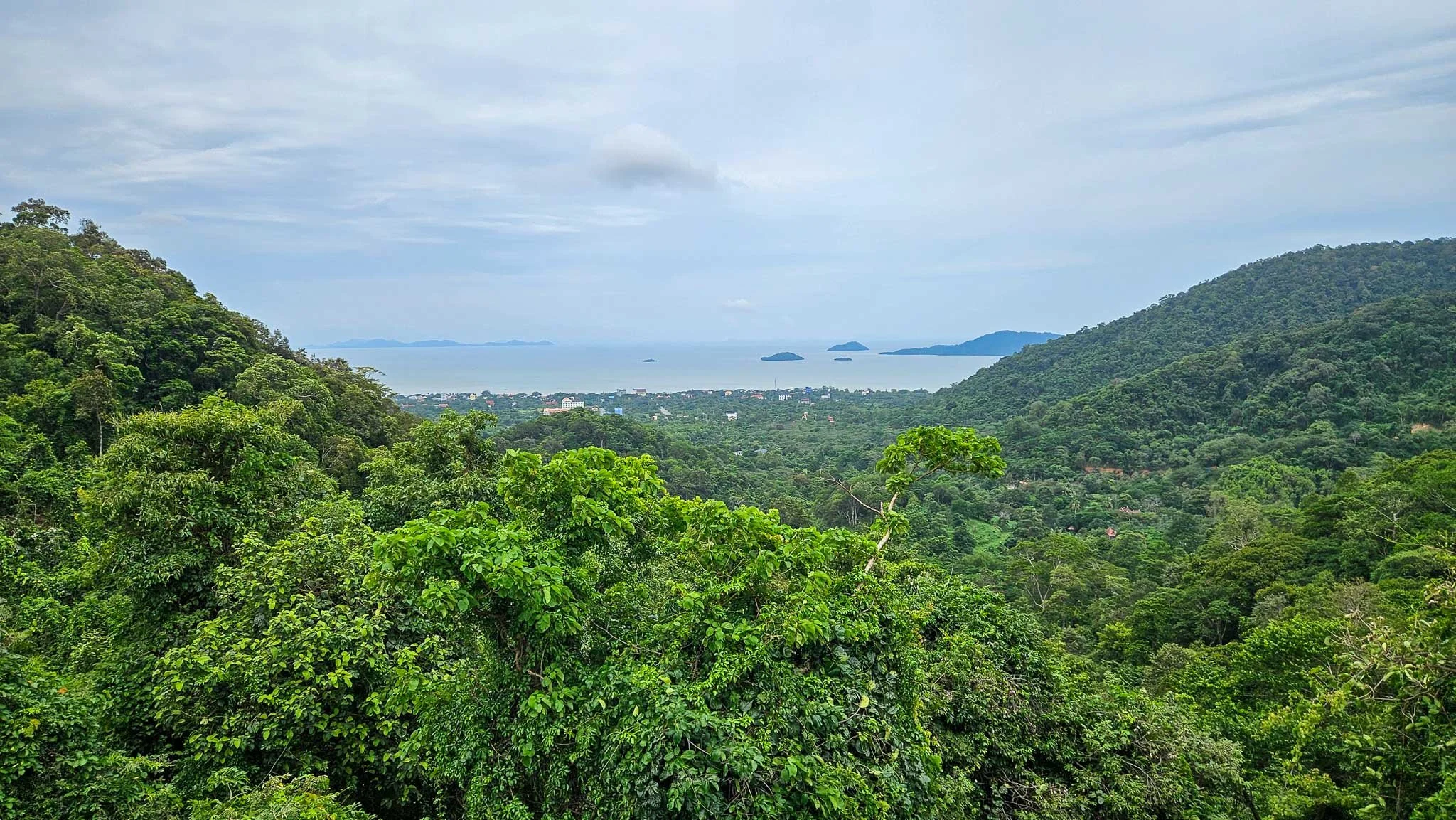
Further on up the winding road, we saw signs for a lookout tower, so we pulled over and went to investigate. A short walk up a jungle track and we were greeted by a tall green metal tower. The view from the top was fantastic. On one side you could see all over Kep town and its beach and the other side commanded views all the way back to Kampot and out over the rest of Kep Province.

After the viewing tower, we cruised through more amazing jungle, stopping for some silly selfies and even catching a glimpse of some hornbills flying overhead.

For $1 each the national park was brilliant. Driving around on our scooter on a jungle road past spectacular viewpoints was well worth the small entrance fee.
After the park it was finally time. Our appetites had been recharged, so we set off to Kep’s famous Crab Market.

Follow us as we explore Kep National Park by scooter!
Kep National Park visitor information
Everything you need to know to have your own adventure through Kep National Park.
Kep National Park location
Kep National Park rises up across the hills behind the seaside town and can be found on a map here. Kep National Park has two entrances / exits. To get into the park you will have to enter here, this is where the ticket booth and car park are. You can either exit the same way you came in, by doubling back along the same path or come out via this backroad here.
When we visited the National Park there was nothing to stop you coming in from the back entrance, there was a small booth but (at least in the wet season) it was unattended. However, we wouldn’t recommend trying to dodge the ticket price. Go in the proper way and support the park!
Ticket prices for Kep National Park
It costs $1 entry each for foreigners to enter the national park. It is free for Cambodian nationals.
Opening times for Kep National Park
The park is open from 8.00am until 18.00pm everyday.
Organised hiking and walking tours of Kep National Park
If you would prefer to explore Kep National Park by foot then why not book a national park walking tour with a local guide? Not only will they be able to tell you about the local fauna and spot some of the wildlife, but they’ll also be able to show you hidden viewpoints most visitors will miss. Click here to book a walking tour in Kep National Park.

Even on an overcast day in the wet season, Kep National Park has some phenomenal views!
Devour a seafood feast at the famous Kep Crab Market
📍Find Kep Crab Market on Google Maps here
The Kep Crab Market was very busy when we visited, but, as we ducked our heads under the brightly coloured canvas and into the huge covered market area, we could straightaway see why the market was so famous.
Rows and rows of stalls selling seafood, condiments, side dishes, drinks and snacks stretched away in an impossible series of dining choices.
We knew we wanted crab so that’s where we started. With the light streaming through the colourful umbrellas and plastic awnings above, we made our way down the fresh seafood aisle.
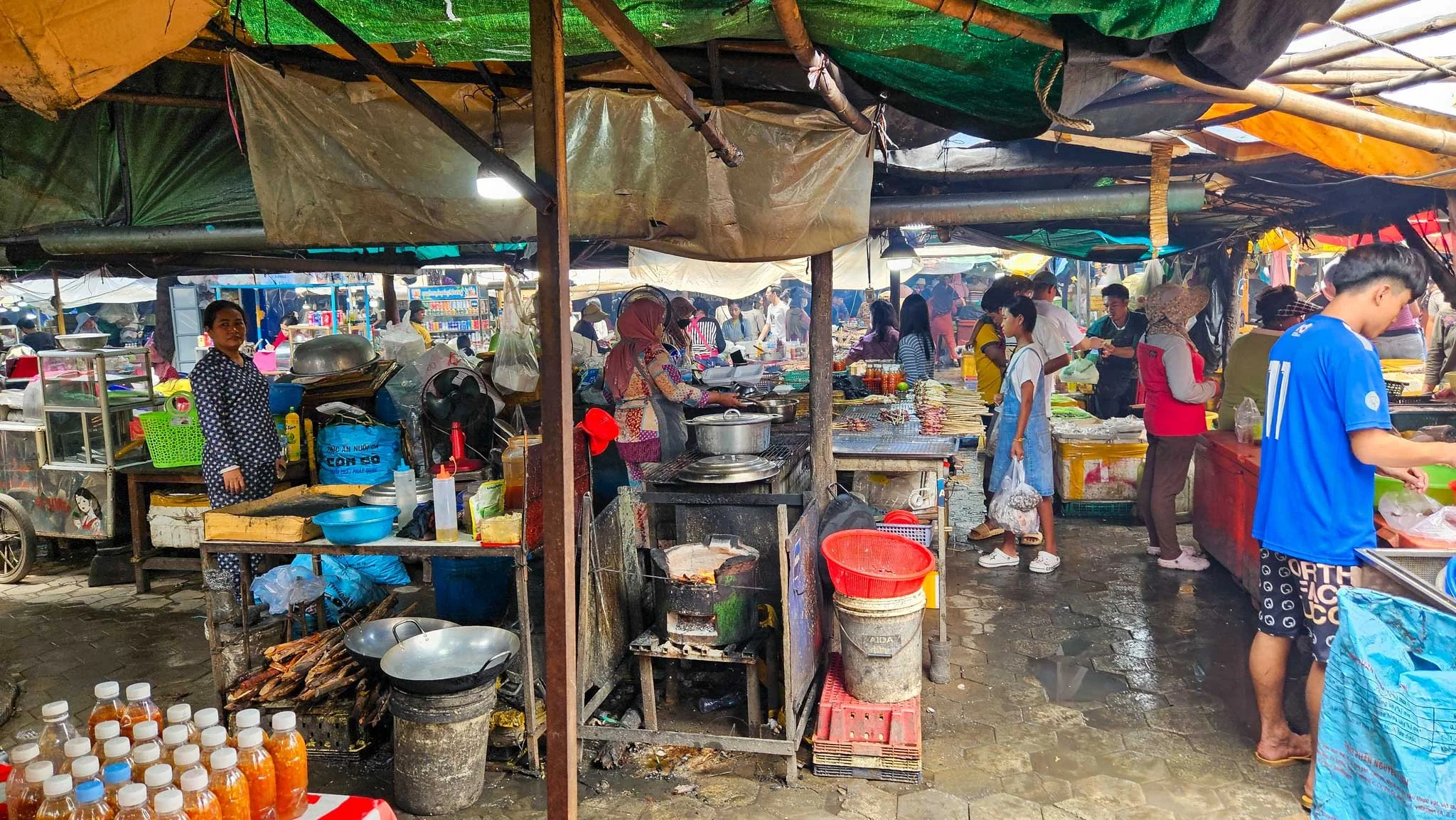
On either side of us bubbling buckets of live seafood lined the narrow path. From giant prawns to blood clams, lobster to squid. If it swam or scuttled in the sea it was up for sale. Everywhere, being sold from every stall, were the famous blue swimmer crabs. The market was a complete assault on the senses, with vendors shouting, wok and charcoal smoke filling the air and the sizzles and smell of frying fish everywhere.

A meal in the market works like this: To order, you head down the narrow aisles until you find the seafood protein of your choice. You buy the live ingredient from the vendor and then take it to be cooked. This can be from the same stall you’ve bought it from, or a different stall, it doesn’t matter and it isn’t rude to buy the crab from one stall and cook it elsewhere. Each stall will have different cooking options to choose from.
Our protein of choice was half a kilo of plump, juicy prawns and half a kilo of Kep’s famous blue swimmer crabs. We had bought a kilogram of seafood for the frankly ridiculous price of $8 USD! Seafood secured, we needed our haul cooked.
The region of Kampot grows what is known as the ‘champagne of peppercorns’. Kampot pepper is used throughout Cambodia and sought out all over the world for fine dining restaurants and discerning home cooks. Kampot pepper has a richer, more complex taste than the standard pepper found on every dinner table. The pepper has floral, herbaceous notes with a slight hint of citrus. These special peppercorns go into making the perfect sauce to pair with crab, the Kampot pepper sauce.
The stall where we had bought the seafood wasn’t cooking with pepper sauce that day, so we simply walked down the aisle and asked at stalls until we found someone to cook us our seafood peppercorn feast.
If you bring your own produce, having your food cooked in the market is seriously cheap. We handed over our prawns and crabs along with $2.50 and, five minutes of roaring wok work later, we were presented with our steaming pile of delicious seafood.

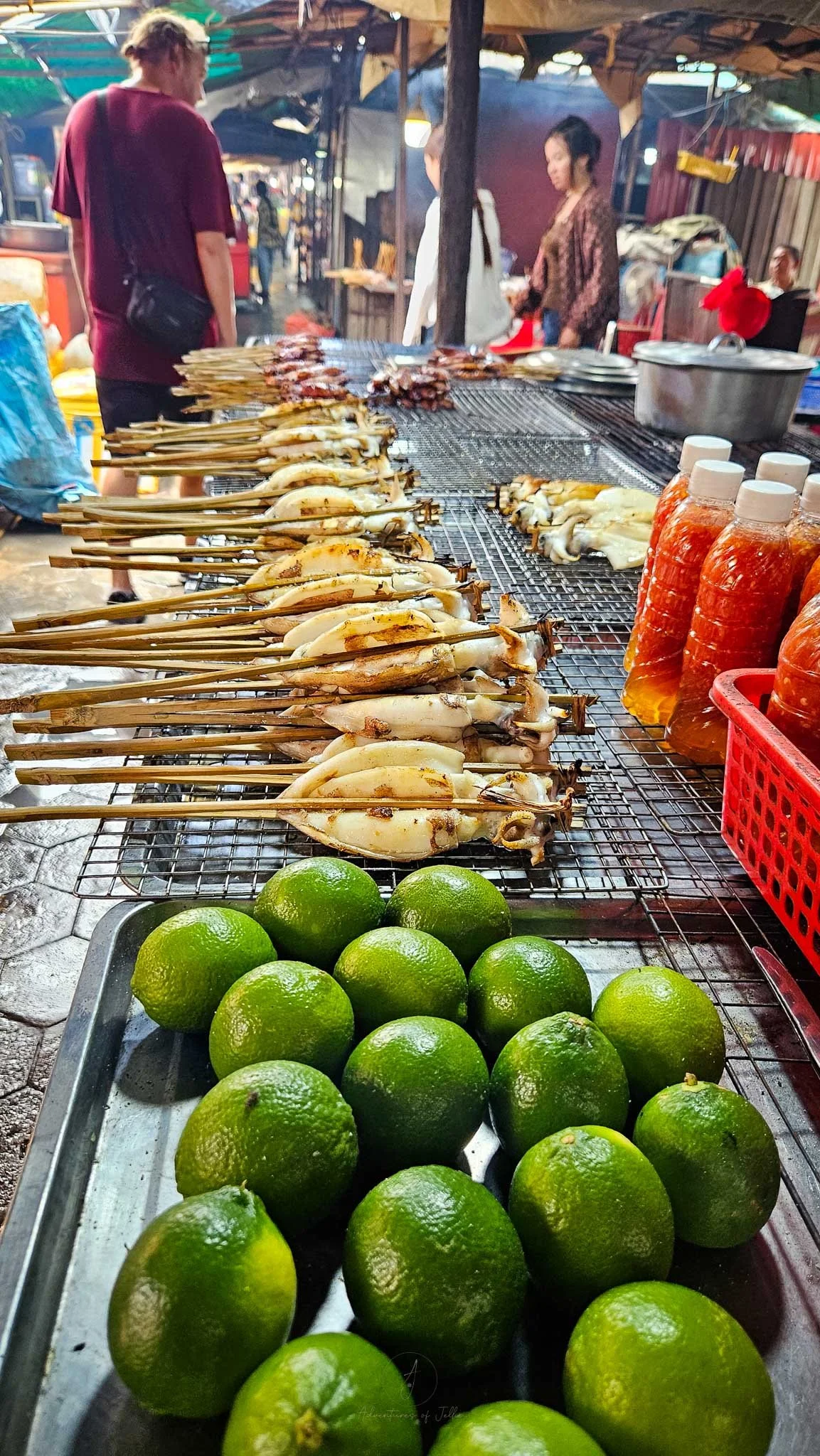
With all the seafood you can opt to have it cooked in different ways and with different sauces / toppings. If you want your crustacea boiled, steamed or fried it can be done. Just ask each stall what sauce they make and pick the one that sounds best. For barbecue cooking, head into the market and choose any of the countless number of barbecue stalls. These stalls cook everything; whole fish, squid, octopus or prawns all done over hot charcoal.

The next stage of eating in Kep market are the side dishes and finding somewhere to eat your seafood feast. With a kilogram of food between two people we didn’t exactly require anything else! But if you’re after anything in addition to your fishy feast there are stalls all around selling vegetables, salads and rice to round off your seafood extravaganza.

To gain a market side dining table, the process is simple; just find a drinks vendor with spare tables, sit down and order drinks. We found a very friendly mother and daughter duo who waved us in enthusiastically to their stall. We ordered two drinks and set out our food. The lovely lady at the stall came back with our cold drinks alongside a bowl of water for cleaning our hands and a healthy stack of napkins. It was time to get messy!
As soon as we opened up our feast, the sweet smell of seafood and pepper hit our noses. Even by the aroma alone we knew we were in for a treat. Over the next half an hour we prised apart shells, cracked claws and sucked and twisted meat from our seafood bounty. Words cannot describe how good it was (but we are going to try)!

Our seafood feast in all its glory!
The crab was incredibly sweet. Firm yet yielding we found ourselves meticulously stripping each of our many crabs for every scrap of delicious white meat we could find. Kep is famous for these blue crabs and after eating half a kilogram of them we can certainly see why.
The prawns were huge. As you stripped the hard shell away you were left with a curled nugget of prawny goodness. They were perfectly cooked, juicy and probably the tastiest prawns we’ve ever had. We can say with absolute certainty that we’ve never eaten fresher prawns or crab. They were caught that very morning, unloaded to the market and we had bought them alive and kicking.
The pepper sauce was divine. Clinging to every sea-foody surface, it permeated every bite with a spicy yet delicate taste. The cooking juices from the prawns and crab mixed with the heady perfumed pepper and created the perfect sauce. A special treat of this Kep seafood feast was taking the prawn heads, dredging them through the sauce and then sucking all the flavour out of them. We’ve said it before when we dined on crab in Batukaras in Indonesia: there is no graceful way to eat crab. The addition of pepper sauce and prawns to peel made our Kep feast a gloriously messy affair. We were very glad of the finger bowl by the end. The whole experience of the market, buying the fresh produce and having it cooked in front of us and of-course, the delicious taste, made this one of our favourite meals in Cambodia and maybe of our whole adventure as well!
Stomachs full and our bikes suspension running a little lower, we headed back to Kampot.

Kep Crab Market - A step-by-step guide on how to order your own seafood feast
For those who need, you know, the actually information rather than a delicious description of what we ate, this is our practical guide to ordering your very own seafood feast!
Where is the Kep Crab Market?
Kep’s famous crab market is located about 2 KM west of the main beach and hub of Kep, just around the peninsula. It is an easy day trip from the traveller and backpacker hotspot of Kampot which is about 27km away (around a 30 - 40 minutes drive).
You can find Kep Crab Market on a map here.
When is the Kep Crab Market open?
The Kep Crab Market is open every day from 5am until 5:30pm with some of the more ‘formal’ restaurants being open until later.
The market opens when the overnight fishermen come in and deliver their haul. The market will wind down and close as the fresh produce sells out. Go earlier for the best selection. For those very experienced in haggling you can actually buy the catch straight off of the boat!
How to buy your seafood of choice
On the ocean facing side of the market you will find all of the “raw ingredients” for your meal - the seafood sellers. Explore these aisles and negotiate prices for what you want to buy. Do not take the first offer!
We spent $8 in total for half a kilogram of crab and half a kilogram of large prawns. We were quoted a range of prices before settling on the $8 per kilo / $4 per half figure, our first shop was offering more than double that price! We’re sure you can haggle better than us, let us know how much your meal was in the comments.

Getting your seafood cooked at the Kep Crab Market
Now you have your seafood it's time to get it cooked. The stall you bought it from will almost certainly be able to cook it for you, just check what sauce you want and know that it's not rude, or a problem to take your seafood elsewhere.
Our stall didn’t offer Kampot pepper sauce so we went a couple of stalls down the row until we found one that did. If you’ve bought your seafood already, the cost of having it cooked should be very low. We paid $2.50 for all our seafood to be prepared, fried and cooked with a pepper sauce.

Another option at the Kep Crab Market - sweet, spicy, chilli sauce prawns!
Also note that you can choose how your food is cooked along with what sauce you want. You can have the seafood boiled, steamed or fried at any of the market stalls. For grilled foods, head into the market where there are dozens of barbecue stalls. These smoky stands will either grill something you bring them or sell you something fresh off the barbecue.
Kep market is a fresh seafood market and so the food you buy should still be alive. Be aware of this if you are squeamish.
Some stalls on the market were unloading frozen produce. If you’ve come all this way to eat fresh seafood, make sure you’re buying it fresh! You can easily spot the difference between the stalls, the fresh are served either live or over ice. The frozen are unloaded inside blocks of ice.
How to purchase side dishes and accompaniments
Now you’ve got your steaming box of seafood, make your way deeper into the market. Here you’ll find stalls selling all sorts of grilled food, along with cooked rice, vegetable merchants and sauce shops. Just haggle your way through, picking up anything you may need.
You can find spicy salads, sticky rice, fruits and anything else you may need to accompany your oceanic feast. We thought our kilo of food was quite enough so let us know in the comments what we missed!
Where to eat your seafood feast in the Kep Crab Market?
Head down to any of the drinks vendors and you’ll see they have tables set up ready for you to use. Just buy drinks (around $1) or desserts from them and they will sort you out with seating, napkins, and, in our case, finger bowls to clean ourselves up with.
Voila, a seafood feast like no other! Do not miss out on this in Kep, you may never eat better for such a little amount of money.
How much did our crab seafood feast cost?
In total our epic crustacean-y culinary Cambodian feast cost us less than $15 - super budget friendly. Honestly, where are you ever getting cooked, freshly caught crab and fresh prawns for anywhere near this price? This is unmissable not just for budget backpackers but for anyone with tastebuds in their mouth.
Guided tours of Kep Crab Market
As you can see, we dined in the Crab Market by ourselves and absolutely loved it, but if you are a little unsure as to whether or not you want to pick out your lunch alive and kicking, then why not book a guided Kep Crab Market tasting tour. This way, a local guide can do all the hard work for you (the negotiation, the choosing of your crab and finding the best wok master) whilst you sit back and enjoy your freshly made seafood spread!
Other dining options - nearby seafood restaurants in Kep
Lining the coast and stretching nearly all the way to Kep Beach are more ‘formal’ restaurants. If you are looking for a more refined setting to enjoy a seafood banquet (maybe even involving air conditioning you fancy fiend you!) then there are loads of sit-down restaurants to choose from.
You will be paying a large premium for eating at one of these sea-side eateries and won’t be picking your produce fresh from the market, but if you want a little more refinement they would be a good choice.
Some more photos from our time at Kep Crab Market




Take a boat trip and explore Rabbit Island (Koh Tonsay)
For those planning a few days stay in Kep or Kampot, then make sure you book a trip over to Koh Tonsay or Rabbit Island. As we were visiting Kep during the rainy season and the weather was extremely overcast, we didn’t do this ourselves, but in better weather, we would love to have a day on the island.
To get to Rabbit Island, just head down to the Koh Tonsay Boat Terminal (location) to buy your boat tickets.
The tickets for the boat for Rabbit Island cost:
Private boat tickets: $25 to $30 (per boats)
Public boat tickets: $8 (each). This boat leaves at 9 AM and returns at 4 PM. There are options to buy other return tickets if you need to leave earlier than 4 PM, just negotiate with the boat ticket sellers or speak with your accommodation on Koh Tonsay.
Be a little wary as according to the reviews the boat sellers are especially keen for you to buy a “private” boat all to yourselves. Whether or not you actually get a private boat seems to be up for debate!
For those looking to stay on the island there are lots of small beachside homestays available. Click the following link to see what accommodation is available for your stay on Rabbit Island. We cannot wait to do this ourselves next time, it looks like a proper old-school tropical paradise!
If you’re staying in Kampot but don’t want the hassle of getting to the pier and organising your boat tickets, then why not check out this full day tour to Rabbit Island which includes transfers to and from Kampot on Get Your Guide.
How To Get To Kep?
Kep is located on the coast of southern Cambodia. Set half an hour away from the backpacker hub of Kampot and around three and half to four hours away from the capital of Phnom Penh. Wherever you’re coming from in Cambodia, Kep is very well-connected!
Kep is also the name of the province (sometimes spelt Krong Kaep) surrounding the town. You can find Kep Province here on a map and Kep Beach is located here.
Getting to Kep from Kampot (renting a scooter vs. tuk-tuk)
For most travellers (and like we did), Kep is usually explored as part of a big day trip from Kampot. The easiest way to reach Kep from Kampot is by road. You can either drive yourself on a rented scooter, hire a tuk-tuk driver or catch a bus.
Scooter rental in Kampot can be found at almost every accommodation within the town. We rented our bike for $5 (with two helmets) for the day from the excellent Karma Trader’s Hotel (see more details below in the “where to stay” section of this article). Our favourite way to explore anywhere is independently by bike and Kep was no different. We love the freedom a scooter gives and love being able to pull up anywhere.
If you’re not confident at hiring a scooter and driving yourself then you can easily rent a tuk-tuk driver to take you to Kep from Kampot. Our recommendation would be to speak with your hostel or shop around in Kampot town. To get the most out of your tuk-tuk rental, make sure you negotiate a full day out that ticks off all the main Kep highlights. Take a look here if you want to book a tuk-tuk tour from Kampot to Kep in advance.
For those planning to stay in both Kampot and Kep, you can easily hop on a bus with your luggage to reach Kep. Buses and minivans depart from Kamport to Kep multiple times a day, everyday. To secure your seat, book your Kampot to Kep bus tickets here.
Scooter parking in Kep
If you’re driving yourself by scooter, parking is abundant and easy in Kep. All along the seafront there are places to pull over and park up. Just beware that some of the seafront parking spaces (usually close to stalls with chairs) will require you to buy something from them.
Kep National Park has plenty of spaces to park if you want to explore on foot, just outside of the main ticket booth is a large car park.
At the Kep Crab Market, it may look chaotic but if you’re on a bike it's not too hard to find a parking space. In the main car park, to the right of the market if you are facing the sea, there is a dedicated motorbike park with attendant. It cost us $0.50 to park here and have the bike looked after whilst we had our seafood feast.

For those driving by car, parking is more limited but still possible. There are car parks at the market, the beach and the national park. Just be warned, they can get very busy especially on weekends and public holidays.
Travelling to Kep from Phnom Penh (buses, trains or private taxi)
The Cambodian capital of Phnom Penh is only a short 3 hour drive (around 160 KM) away from Kep Beach. Depending on what level of comfort you require when travelling, there are plenty of options to take you from Phnom Penh to Kep.
By bus or minivan
The easiest way to reach Kep from Phnom Penh is to hop on to a bus or minivan. Buses depart the capital everyday, with services departing from early morning till late afternoon and journeys taking between 3 to 5 hours to reach Kep. All the main Cambodian bus companies serve the route (Giant Ibis, Ekareach Express and Vireak Buntham), just click here to book your bus ticket from Phnom Penh to Kep in advance.
By train
If you would like to take a ride on Cambodia’s Royal Railway, then there is only one departure a day with trains leaving Phnom Penh Railway Station at 7:00 AM every morning and arriving at Kep Railway Station (location) at 10:40 AM. To book tickets, just head to the railway station in Phnom Penh or book your train ticket online in advance here.
If you are planning to get to Kep by train, then just be aware that the railway station is located around a 15 minute drive away from Kep Beach so you’ll need to grab a tuk-tuk or taxi to take you on to your accommodation from the station.
By private taxi
A taxi to Kep is by far the easiest and most comfortable way to travel. If you’re short on time, or travelling with lots of luggage, then a taxi will take you straight to where you want to go. To book a taxi in advance to Kep then we would recommend using 12Go.
If you are heading Kep either before or after a stay in Phnom Penh and want to try your hand out at some more market munching, then make sure you take a look at our “Complete Guide to the Markets of Phnom Penh”.
Getting to Kep from Koh Rong Island or Sihanoukville (buses or private taxi)
For those backpackers who are travelling from the islands of Koh Rong, Kep sits only a 5 hour ferry and bus ride away. To check times and prices or to book your combined ferry and bus ticket from Koh Rong, then make sure you check 12Go.
If you are staying in Sihanoukville, Kep is only a 3 hour drive away down the coast. Depending on your travel style, you can either hop on a bus or book a private taxi. Take a look at your Sihanoukville to Kep transport options here.
Guided Tours & Organised Trips To Kep
For those not eager on driving yourself from Kampot to Kep, then you can easily arrange a guided tour. Most tours will even include pick up and drop off in Kampot. Take a look at the widget below for some different organised Kep trips:
Kep or Kampot? Where to stay?
As both Kampot and Kep are only a short 30 minute drive away from each other, it depends on what you want from your trip to southern Cambodia. We’d recommend you …
Stay in Kep: if you want a more chilled out, laid-back beachside break.
Stay in Kampot: if you want backpacking vibes, hostels, cafes and bars.
On this trip to Kep, we stayed in Kampot and took a day trip to Kep. Next time we’re in Cambodia, we would like to spend a day or two relaxing by the beach in Kep (alongside a night or two on Koh Tonsay) before heading back up the coast and spending some time in Kampot.
Kep accommodation
If you want to stay close to Kep Beach or Kep Crab Market, then there are plenty of small guesthouses, boutique hotels and upmarket resorts all lining the shoreline. Click here to book a bed for your stay or check out our handy map below to see all the accommodation on offer.
Kampot accommodation
We stayed in the fantastic Karma Trader’s hostel and travelled from Kampot to Kep as part of a day trip. Karma Trader’s was one of our favourite hostels we have stayed at in all our travels. To find out why we loved it so much, take a read of our full Karma Traders article.
If you don’t fancy staying in a hostel, there’s plenty of other Kampot accommodation on offer.
Our Kampot travel guide
For those planning a stay in Kampot either before, during or after your stay in Kep, make sure you check out our full Kampot travel guide to the town. We cover everything there is to see and do, our favourite cafes and much more!
When To Visit Kep? Wet & Dry Season In Kep
Kep is a seaside town and its beaches benefit greatly from blue skies and good weather. The dry season in Kep runs from October to May. During this time you will have many more days of sunny skies making it the optimal time for beach-based basking. The dry season is also prime for those wanting to go swimming on Kep Beach as the sea will be a lot calmer and a lot clearer than in the wet season, making it perfect for swimming and snorkelling.
As it is Cambodia’s dry season, Kep will be a lot more busy with both local tourists and other travellers. Prices for accommodation will be higher and beds can sell out extremely quickly. We would highly recommend you book your accommodation in advance if you’re planning a trip to Kep in the dry season.
During the wet season, from June to September, the weather will be extremely humid. It will rain for a portion of most days and when it's not raining, you’re more than likely to have some overcast skies. Even in the height of the wet season you will still get the occasional spell of good weather, but it is less reliable.
When we visited Kep it was during the rainy season. We did have parts of the day where it was sunny, but for the vast majority of our days there, the skies were overcast with thick clouds.
All the negativity now out the way, we really enjoyed visiting Kep in the wet season. The paddy fields on the drive down were verdant green, the air was cooler and the heat (at least on the day we visited) slightly less oppressive. The national park was blooming and gorgeous and the famous Kep Crab Market, busy as it was, was much less crowded than it would have been in the height of the high season.
If you are looking for a beach break then the dry season is the obvious choice, but if you’re in Cambodia during the wet months, don’t write off Kep, it is still gorgeous.
Is Kep Worth A Visit?
Absolutely! If you’re already travelling around southern Cambodia or are planning a trip there, you should definitely not miss Kep. Even if it's not the season for beaches, the seafood alone and natural beauty make it worth the visit. Our seafood bounty at the Kep Crab Market is one of those meals we will remember forever, from haggling over crab, to the feast itself it is hard to imagine a better lunch! Aside from the crabs, Kep just had so much to offer, stunning views, wildlife and its amazing coastline all make this a fantastic little region to explore. Kep felt (at least in the wet season) like a real place, somewhere where locals visit and not somewhere just put on for tourists. We absolutely loved our time in Kep and cannot wait to go back. Hopefully next time it will be beach weather!
Thanks for reading,
John & Ellie x
#adventuresofjellie
All Our Kampot Travel Guide
If you’re heading to Kampot or lucky enough to be already there, make sure you take a look at all our Kampot travel guides, where we share everything from our favourite cafes to exploring a national park stuffed full of abandoned hill stations.

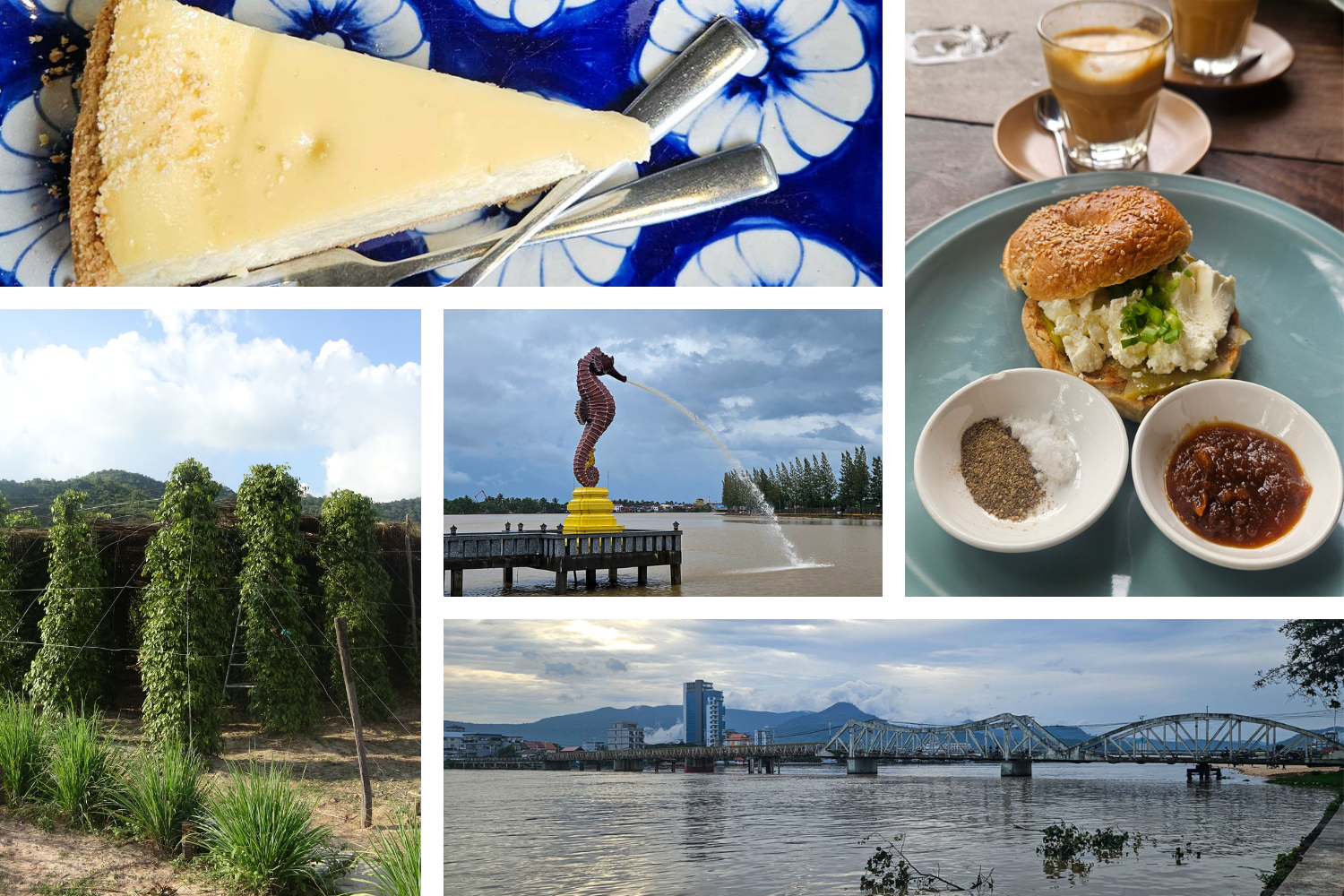
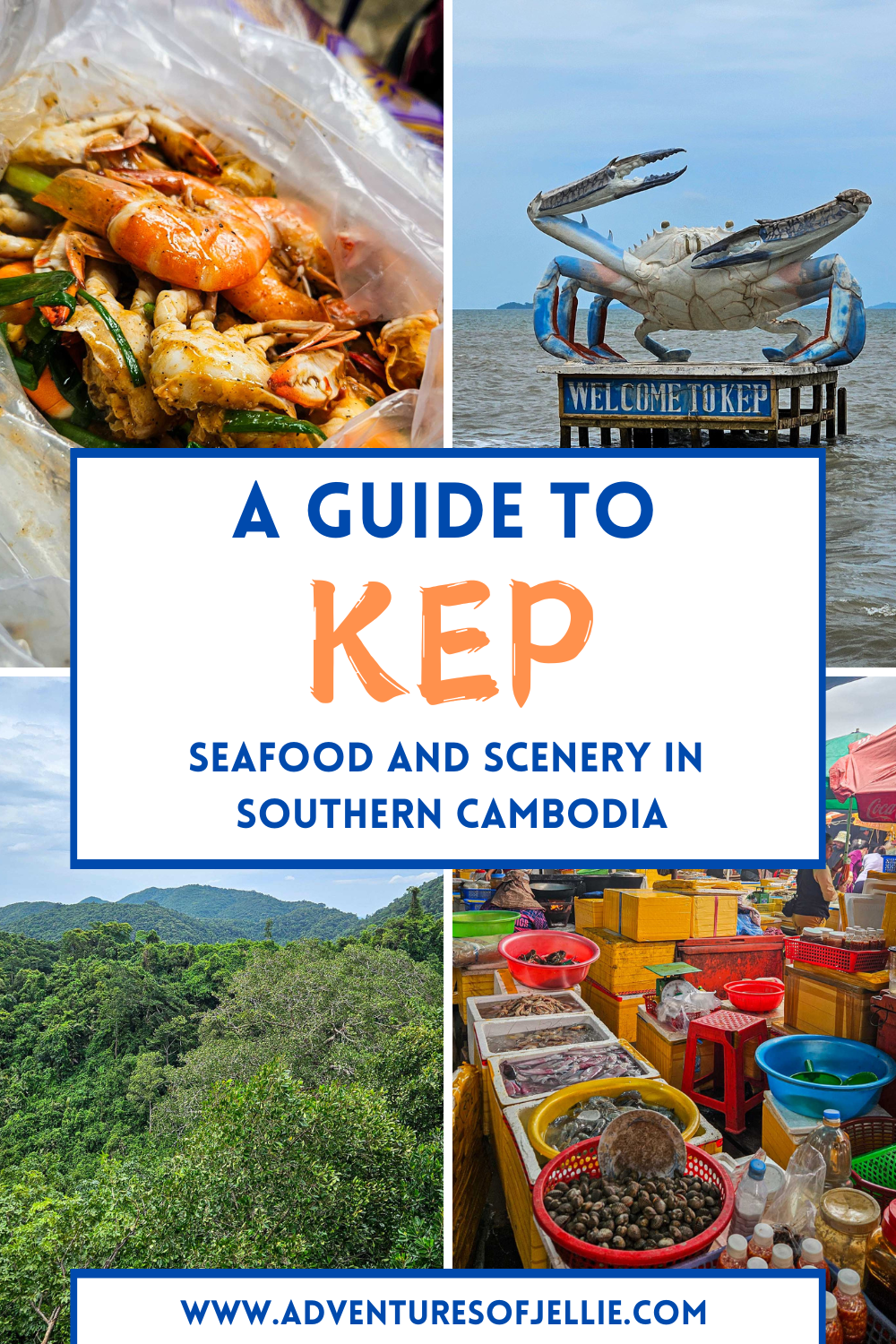
If you’ve enjoyed reading this article, why not save the pin below?
Bokor Hill Station and National Park are a mysterious and beautiful destination in Cambodia. Come with us as we drive past troupes of monkeys, up a winding mountain road to visit the mist-clad ruins and abandoned church. Our complete guide has all the must know information for visiting Bokor Hill Station and National Park.