Anuradhapura - A Tale of Sunburn, Flat Tyres and Ruins in Sri Lanka’s Ancient Capital
The ruins of the ancient capital of Anuradhapura are mysterious, beautiful and spectacularly vast. The UNESCO ruins of the sacred city are part of Sri Lanka’s legendary Cultural Triangle and are home to hundreds of ruins, temples, lakes and even some enormous elephant baths!
Less visited than the mighty ruins of Sigiyira, many travellers skip or aren’t even aware of Anuradhapura. How do you visit? What’s it like? Where, in fact, is Anuradhapura? Come with us and we will answer all your questions! This is our guide to this amazing archaeological site and all you need to know for visiting.
In this guide to the Ancient City of Anuradhapura:
Disclosure: This article may contain affiliate links. We will earn a small commission from any purchases made through these links.
Quick history lesson - What is Anuradhapura?
This is a very quick, very brief history lesson, so if you’re interested in learning more about the Ancient City, you can check out some more learned information here, but the basics are…
Anuradhapura was founded in the 4th century BC by King Pandukabhaya. For over 1300 years, Anuradhapura served as Sri Lanka’s first capital and grew into one of Asia’s most important spiritual and sacred places.
Buddhism was first introduced to Anuradhapura in the 3rd century BC by King Devanampiya Tissa. Around the same time, the city was given a cutting from the Buddhist ‘Tree of Enlightenment', (the original Bodhi tree in India under which the Buddha attained enlightenment). This bodhi tree cutting was planted in Anuradhapura and the city quickly became the spiritual centre of Theravada Buddhism. The Bodhi tree (known as the Jaya Sri Maha Bodhi) can still be seen in the Ancient City today.
Over the centuries, Anuradhapura was invaded by many different powers and was eventually abandoned in favour of Polonnaruwa in 993 CE. After the abandonment of the city, the jungle eventually took over and the Ancient City remained hidden from view until the 19th century.
In the 19th century, British explorers and archaeologists rediscovered the city and Anuradhapura was eventually awarded UNESCO World Heritage Status in 1982. Today, more and more of the city is being unearthed from the forest and the Ancient City remains an important spiritual site for Buddhists worldwide.
Essential tips for visiting Anuradhapura Ancient City
Anuradhapura is a huge site and you’ll need to dedicate a full day to explore the vast ruins. Here’s everything you’ll need to know before you go!
Where is the Ancient City of Anuradhapura?
The archaeological ruins of the old city, sit just to the northwest of Anuradhapura’s New Town. You can find the Anuradhapura Ancient City on Google Maps here. There are several entrances to and from the park, make sure you have a valid ticket for the duration of your visit.
Opening times
The site is open from 7 AM until 5.30 PM everyday. If you can, get there early in the morning to beat both the crowds and to escape the heat. Sri Lanka’s tropical climate is very hot and humid.
If you want to visit the archaeological museum, it is open from 9 AM until 4 PM everyday apart from Tuesday when it is closed.
Ticket prices and where to buy them
Tickets cost $30 USD each to enter the Ancient City.
The prices are listed and charged in USD but you can pay for your ticket in LKR (the rate depends on the exchange rate for that day).
Make sure to bring enough cash with you as when we visited it was cash only. There are plenty of ATMs and banks in town.
Ticket counters are dotted all over the site. We entered from the south and bought tickets from a small counter close to the Isurumuniya Temple. If you’re coming from Anuradhapura’s main railway station, there is a ticket booth just next to Ruwanmeli Maha Seya and another ticket counter north of the Jethawanaramaya Stupa.
Dress code / temple etiquette
Anuradhapura Ancient City is a holy site and an active place of worship for Buddhists. If you’re planning a trip, you will need to dress appropriately. When visiting, men and women will need to ensure their shoulders and knees are covered. Shorts, hot pants, crop tops, vest tops and tank tops are all not allowed!
At most of the temples within the site you will need to remove your shoes and any hats. If you’re worried about losing your shoes, there’s usually a shoe-storage counter where you can store your shoes with someone for a small fee. A word of warning though, the stone floors of the temples can get extremely hot, so if you’re wearing sandals you may want to protect the soles of your feet with some socks.
Inside any of the temples remember to be respectful. This includes keeping your voice down and not turning your back to any Buddha statues or stupas. Also it goes without saying, please refrain from any displays of affection. Anuradhapura is a pilgrimage spot, save the PDA for the hotel!
Pack extra sun cream and water, the sun is very intense! We thought we would be protected (SPF 50 crew here) for our visit but, due to some unexpected extra exertion (find out more later) we ended up like lobsters by the end of the day!
How to get around: Renting a bike versus hiring a tuk tuk driver
The sacred city is massive and the sites are all spread out. To get the most out of your day you’ll need a set of your own wheels, whether that’s pedalling yourselves, scootering around or hiring a tuk tuk driver.
Renting a bike in Anuradhapura
We opted to rent bikes for the day, choosing to hire them from our guesthouse, the Villa DeLorenta in the heart of the New Town. Bike rental seems to be standard across town with a full day’s rental costing between 1500 LKR and 2000 LKR.
Almost all of the guesthouses and hotels in town will have bikes to rent for the day or if they don’t, just head to Cosmic Rent Bicycles in town or to Sun Cycles in the Ancient City.
If you would like to arrange a bike tour with a local guide then there’s plenty of places you can head to within the site itself. Just head over to Mighty Trails Bicycle Tours or if you would prefer to book a bike tour in advance, why not check this Anuradhapura Heritage Guided Cycle Tour on GetYourGuide.
Hiring a tuk tuk driver for the day
For those who would rather sit back and let someone else drive them around the archaeological ruins, then you can easily hire a tuk tuk driver for the day. Once you arrive in Anuradhapura, just speak to your accommodation and they’ll be able to arrange a driver for you.
If you do plan to hire a tuk tuk driver, make sure you plan your day in full and negotiate prices. To book a tuk tuk driver and tour guide in advance, why not check out this Anuradhapura tuk tuk experience on GetYourGuide.
Renting a scooter / motorbike in Anuradhapura
If you’d rather have your own motorised transport then there are plenty of spots in town where you can rent a scooter or a motorbike. Why not check out Tuk Tuk RentRo in town or the Rides Hub set within the Ancient City.
Scooter rentals are usually around 10 USD for the whole day (around 3000 to 4000 LKR) depending on where you rent from. There are plenty of car park spaces outside each of the main sites within the city.
How much time do you need in the Ancient City
Plan to spend at least one full day exploring the Ancient City. As we’ve said above, the site is enormous and there’s plenty to see. We spent a whole day ourselves cycling around and still didn’t get to see it all!
If you have hired a tuk tuk driver you could obviously do it a lot quicker than we did, but honestly, we loved spending a full day cycling around Anuradhapura.
Food and drink options within Anuradhapura Ancient City
If you’re planning a full day exploring then make sure you bring along a picnic lunch! When we visited there were a few cafes (this is a very generously applied term!) but nowhere to really get more than an ice-cream, roti or a couple of samosas. There are plenty of small shops dotted all over the sacred city to buy water or soft drinks from - obviously these are all cash only joints!
When is the best time of year to visit?
The ultimate time to visit the ruins are between January and March when the weather will be dry and sunny but not too hot. This is the peak season for tourism so make sure to book your accommodation and transfers well in advance.
The shoulder season runs between June and September. During this time the weather will be extremely hot (plus 35 degrees on some days) but the site will be quieter. The only exception to this is during the Poson Poya celebrations that fall under June’s fall moon. This Buddhist celebration is the second biggest festival in Sri Lanka and many locals take a pilgrimage to both Anuradhapura and the nearby sacred mountain site of Mihintale.
If you can, try and avoid visiting between October and December. This is the monsoon season in this region of Sri Lanka, and although the ruins will be quiet, you can expect a lot of rain. The ancient city is all outside and we can imagine a lot of the roads in and out of the site will become quagmires during heavy rainfall.
What to see in the Ancient City of Anuradhapura: Our experience cycling around the sacred ruins
After a nice night in our small guesthouse (the comfy, yet budget friendly Villa DeLorenta - more on this later), we woke early and rented two bikes before setting off onto the busy, dusty streets towards the ruins. Weaving in between tuk tuks, dodging cars and scooters and even the occasional bus, we eventually turned off from the main road onto a quiet country lane towards the Ancient City.
We ended up taking (not intentionally) the back road into the ruins. At least we assumed it was the back road into the site, as the main entrance to the Ancient City almost certainly isn’t located next to the local prison! After the chaos of the main road, this back road was peaceful and calm. Either side of us, lush green paddy fields lined the road and above us swaying coconut trees gave a small window of shade. As we cycled on, we passed by confused locals (again, we were definitely not taking the normal route in) and zoomed past waving school children. We even spotted some colourful peacocks wandering through the green fields. We stopped for photos along the way and admired the scenery. If the back road into Anuradhapura was anything to go by, we were definitely in for a treat!
As we cycled further into the sacred city, we started to spot houses and farmland. Unlike other archaeological sites we’ve visited around the world, the city isn’t gated off and local people live in villages and houses set amongst the sacred ruins.
After a short while cycling we stumbled upon a small booth sat on the side of a junction in the road. We purchased two tickets and paid $30 USD each for entry. Along with our tickets we were given a shoddily drawn map with a couple of ruins circled. Feeling a bit like budget versions of Indiana Jones’ we set off on our ruin hunting expedition!
The morning sun, although hidden behind a humid blanket of cloud, was intense but we were fully lathered up in sun cream, and ready to take on the vast site, or so we thought…
Ruwanmeli Maha Seya
📍Find the Ruwanmeli Maha Seya on Google Maps.
The first “site” we stumbled upon was the Ruwanmeli Maha Seya. When we say stumbled, what we should say is that we could see the top of this stupa from a good distance away from its base. Against the grey skies, the bright white stupa looked almost luminescent. Instead of stopping here, we cycled past and decided we would return here later in the day on our way back home.
The Ruwanmeli Maha Seya stupa holds significant importance within the Buddhist world. The base is made up of hundreds of carved elephants, standing in rows, supporting the enormous stupa above. Inside, it houses the largest collection of Buddhist relics found anywhere within the world.
Abhayagiri Vihara Stupa
📍Find the Abhayagiri Vihara Stupa on Google Maps.
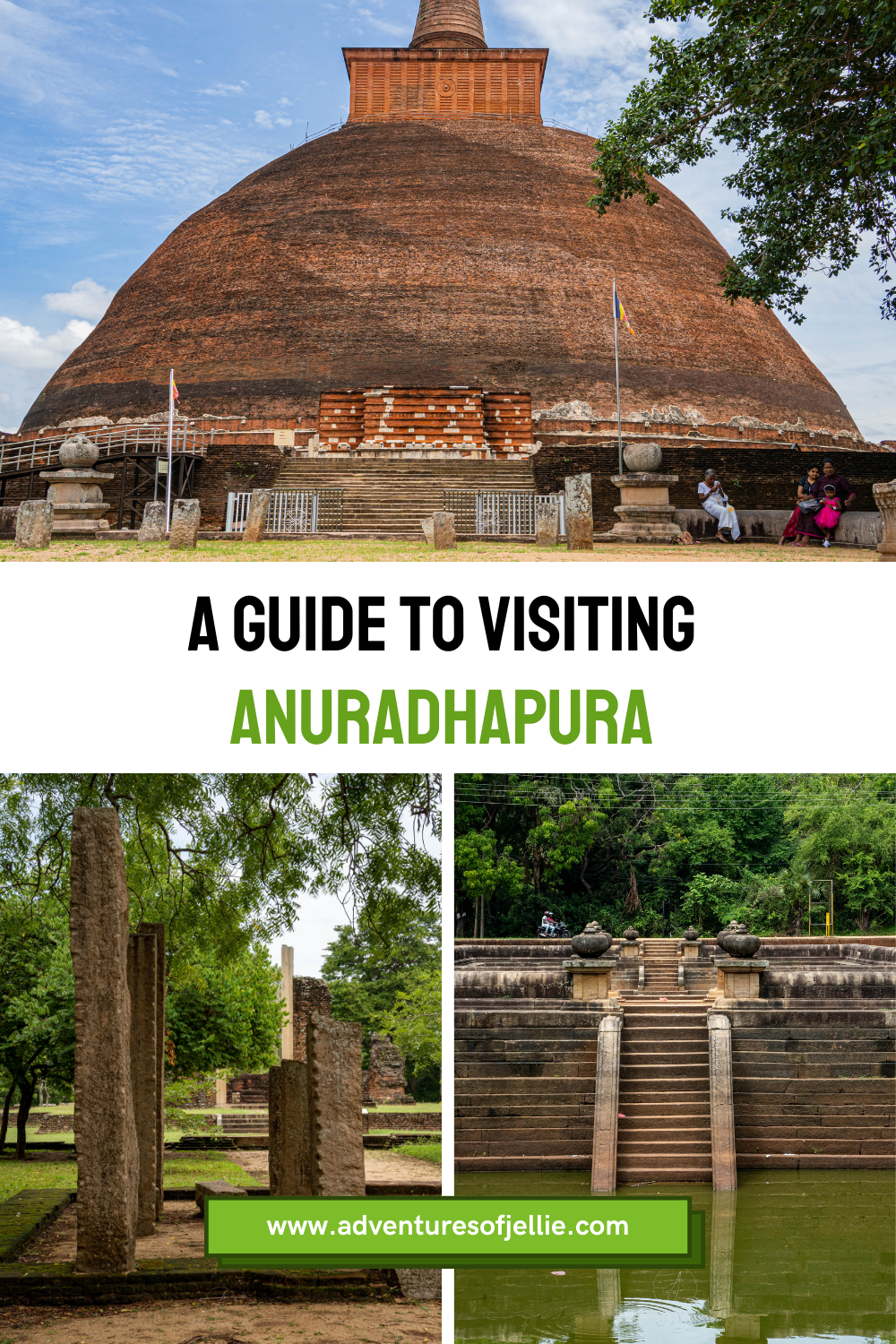
Our first actual stop was the gargantuan stupa of Abhayagiri Vihara. Nearly entirely intact and still an active site of worship for Buddhists, the temple dominates the surrounding landscape. The clay colour of its brickwork contrasting against the green jungle and blue sky and its dome towering impossibly high overhead.
We circled around the enormous stupa, looking up in awe at the colossal monument above us. At the base, statues of the Buddha sat, stood and stared out at us. All blanketed in a covering of bright purple lily flowers.
The Abhayagiri Vihara Stupa is just one of the buildings that made up the vast monastery. Leaving our bikes in the carpark, we wandered around the surrounding temple and palace complex. Walking through ruins of ancient shrines and monasteries, we were accompanied by leering macaques, crowing cockerels and feeding cows. At one point we encountered a troop of langur monkeys, as they hopped and lolloped along the ancient streets.
We took a break from the heat, at the enormous Elephant Pond. We don't know if this was where elephants were bathed, but Ellie did entertain herself with thoughts of an elephant day spa.. trunk massage anyone? Just imagine how long it would take to give an elephant a pedicure!
Anuradhapura Moonstone
📍Find the Anuradhapura Moonstone on Google Maps.
Sitting a short cycle ride away from the ruins of the Abhayagiri Vihara Monastery is the incredible Anuradhapura Moonstone.
Moonstones (or Sandakada Pahana as they are known in Sinahelese) can be found marking the entrances to many Buddhist buildings within Sri Lanka. These intricately carved stones are named “Moonstones” due to their unique shape that looks a little like a moon!
The Anuradhapura Moonstone is an especially fine example. Four rings fill its semi-circular face, with each ring filled with different animals. The stone carving was beautiful and amazingly preserved for such an ancient relic.
We’re not going to share a picture here as we thought the Moonstone was stunning and we don’t want to spoil it for anyone planning a visit!
Next to the car park of the Anuradhapura Moonstone is a small collection of cafes, coconut sellers and tourist tat vendors. We cooled off with a sugar fix in the form of a soft drink and an ice cream before hopping back on our bikes towards the Twin Ponds. This is when things all started to go wrong for John and his bike …
The Kuttam Pokuna: The Twin Ponds
📍Find the Kuttam Pokuna (Twin Ponds) on Google Maps.
Arriving at the ponds, I turned to see John struggling a 100 metres or so behind… This was unusual for him as he normally likes to race on ahead. Panting, he drew alongside and complained that he seemed to be having a lot of trouble peddling his bike. Attributing it to the fact that we hadn’t done any real cardio exercise since leaving London and we had drunk more than one bottle of Lion over the last few weeks, we got off and explored the ponds.
The Kuttam Pokuna or Twin Ponds as they are known in English are exactly what they say they are, two enormous ponds of water. We feel that describing them as ponds really doesn’t do the Kuttam Pokuna justice. What the Twin Ponds are, at least to us, are some of the prettiest stone baths we have ever seen!
Sitting directly opposite each other, the stone rectangular steps of each of Kuttam Pokuna lead down to vast, green pools of water. On each side of the baths, huge carved stone domes mark the steps down and on all sides is evidence of the elaborate stone plumbing system used to fill the baths. Given the age of the baths, it’s an incredible sight to see! Before you leave, make sure you look out for the intricately carved Naga set into the stone wall of the northern pool.
After spending a while snapping photos and taking in the serene atmosphere of the Kuttam Pokuna we headed back to our bikes. Next to where we parked, was a whole troop of monkeys, with two monkeys that were particularly amorous (John started humming a certain song by the Bloodhound Gang)!
As we hopped onto the bikes, John immediately realised what had been his issue. His back tyre was now extremely flat! We were now a good hour and a half ride back to our guesthouse and were in no mood to cycle out of the park and back again to find out if our (expensive for Sri Lanka) tickets were multi entry. Reasoning that his tyre wasn’t entirely flat, John decided to soldier on. This example of stiff upper lipped Britishness (not to be confused with stubbornness, no sir!) lasted all of five minutes as the last of the air escaped the tyre. John was now riding on the thin metal rim of the wheel with the now useless rubber tyre flopping and dragging around behind him. Admitting defeat he climbed off the bike and began to push.
At first this sounded to me awfully like a John problem, however when trying to cycle at his reduced pushing speed, I discovered that no, this was going to be an us problem! So in the 35 degree plus heat right in the middle of the day we both began a sweaty push onward to see what other hidden gems the Ancient City had for us!
We have to note here about the incredible kindness of strangers we found that day. Three different people from three different houses tried to inflate John’s tyre. Over the course of the day we were invited into two separate homes and offered tea. Throughout, Ellie was treated like a little princess, whilst John helpfully looked on, as more qualified people attempted to re-inflate his tyre. All well meaning efforts were in vain, the tyre was busted. NO amount of pumping (or swearing at it) could convince it to re-inflate.
The only options were either; give up and go back to the guest house or continue pushing on… it was an easy decision, we decided that the remainder of our sightseeing would need to include pushing two bikes across the vast site. So cue one very sweaty, perspiration inducing trundle around the ruins. Over the rest of the afternoon, we rolled past colonnades of abandoned palaces, admired vast stone arches and stared out across ornately decorated Bodhi trees.
What no-one tells you in any guide book is just how big Anuradhapura’s Ancient City is!
Jethawanaramaya Stupa
📍Find the Jethawanaramaya Stupa on Google Maps.
The final stop on our ruins quest was the incredible Jethawanaramaya Stupa, Sri Lanka’s largest stupa. This enormous brick dome structure sits like a vast bell, squatting in the middle of the vibrant green, jungle landscape.
The Jethawanaramaya Stupa was in a more advanced state of decay than the Abhayagiri Vihara (the first stupa we saw). The stupa’s crown was cracked and a carpet of green partially covered one side. It was almost nice to see such a vast building in this state. It did remind us that we were in a truly ancient site and that, excitingly, any of the surrounding hills or jungles could reveal more treasures like this.
It was here where we left our bikes parked in the car park and headed back towards the gleaming white stupa of the Ruwanmeli Maha Seya we had passed by earlier. We snapped some photos outside and then headed back to our bikes. Our lust for archaeology fully satisfied, we decided to call it a day and began the very long push home!
It was only when we got back to our guesthouse where we realised just how much we resembled lobsters 🦞 Despite the sunburn, it had still been a fantastic day!
Jaya Sri Maha Bodhi (The Sacred Bodhi Tree)
📍Find the Jaya Sri Maha Bodhi (The Sacred Bodhi Tree) on Google Maps.
We mentioned the sacred Jaya Sri Maha Bodhi tree at the beginning of this article, but unfortunately we have to be honest and say we didn’t actually end up seeing it ourselves. With our shoddily drawn map and our broken bike we didn’t actually head out of the park the same way we entered. In the morning we had missed the turn off to see the tree and instead took the left hand fork that drove us away, further into the countryside. It’s definitely one for next time!
If you do see it, please share your thoughts and let everyone know what we missed in the comments below.
Our map of everything there is to see in the Anuradhapura Ancient City
To help you plan your day around the sacred city, we have saved every place we discuss in this article in our very own custom Anuradhapura Ancient City Map.
Make sure to save everywhere we have mentioned in your own GoogleMaps for offline use, or, to make sure you have data whilst on the ground, why not buy a Sri Lankan eSIM from Airalo.
Guided tours of Anuradhapura Ancient City
As you can see, we opted to explore the Ancient City by ourselves but obviously, that meant that we had to do all the research ourselves, cycle through 35 plus degree heat and definitely missed some of the ruins!
If you would prefer to have the whole day taken care of and have someone give you all the history, then you can easily book a guided tour whilst on the ground in Anuradhapura. Just speak to your guesthouse or hotel and they’ll easily be able to arrange a tour guide for you. Alternatively, if you’d prefer to arrange a cycle tour, just head to the Mighty Trails Bicycle Tours office set within the grounds of the ancient city.
If you want to avoid haggling or just like to have everything arranged in advance, then, why not take a look at the following options:
🚲 Discover secret temples and local life amongst the Ancient City with this full day cycle tour
🛺 Explore hidden temples and ancient stupas whilst learning about the history on this full day tuk tuk tour in Anuradhapura.
If you’ve got more than a day in Anuradhapura, why not consider booking this sunrise or sunset tuk tuk tour to Mihintale, which takes you to and from Anuradhapura to the nearby sacred mountain (12 km away). We didn’t get a chance to explore Mihintale but it’s definitely on the ‘next time we’re in Sri Lanka’ list.
How to get to Anuradhapura
Anuradhapura sits in Sri Lanka’s North Central province, around 200 km (124 miles) away from the capital Colombo.
📍Find the town of Anuradhapura on Google Maps here.
Anuradhapura is just one of the ancient capitals that form Sri Lanka’s historic Cultural Triangle, with Kandy sitting directly south of the city and Polonnaruwa to the southeast.
Despite being quite a small town, Anuradhapura has excellent transport links with daily connections to the capital Colombo, Kandy and Dambulla to the south and Jaffna to the north. Read on to find out how to get to and from Anuradhapura.
Getting to Anuradhapura by train
📍Find Anuradhapura’s Railway Station on Google Maps here.
Anuradhapura’s Railway Station sits on Sri Lanka’s Northern Train Line which has trains running daily between the country's capital of Colombo and Jaffna in the north.
Anuradhapura is a perfect halfway point to break up the long, 12 hour plus train or 7 hours plus bus journey from Colombo to Jaffna.
Tickets for Sri Lanka’s railway network go on sale 30 days before the departure date.
There are actually two railway stations set within the town of Anuradhapura. The main Anuradhapura Railway Station linked above and Anuradhapura New Town Railway Station (which you can find here on Google Maps). The Anuradhapura Railway Station is closer to the Ancient City and the New Town Train Station is closer to the bus station, shops and main town. Depending on where you're staying, the New Town Train Station may be closer to your accommodation. Both train stations serve the Northern Line with daily trains heading either south to Colombo or north to Jaffna.
Getting to Anuradhapura by bus
📍Find Anuradhapura’s Bus Station on Google Maps here.
We took an easy four-ish hour bus journey from Kandy straight to Anuradhapura. If you’re coming from Kandy there are both public and private buses that serve the route, as well as plenty of smaller air-conditioned mini vans that ply the route frequently. We opted for the slightly fancier, mini van method. This decision was made by the important cost benefit analysis of:
The mini van was already there right in front of us.
The mini van was ready to go.
Most importantly, the day was hot, the mini van had AC and we were too lazy to find the public bus!
We paid 3120 LKR for two tickets plus an extra seat to store our large backpacks. Bus tickets from Kandy to Anuradhapura should cost anywhere between 400 LKR to 1600 LKR depending on whether you catch a local public bus, private or an air-conditioned mini van.
Our advice is that wherever you are (Kandy, Dambulla, Colombo etc), just head to the local bus station and hop on any bus bound for Anuradhapura. We used the buses all over Sri Lanka and always found the bus staff to be super helpful.
To book bus tickets in advance, click on the following links:
Getting to Anuradhapura by private taxi
For those looking for a little bit of luxury during their Sri Lankan adventure, then you can easily book a private taxi. Just head over to 12Go, enter your pick up location and the dates you want to travel.
Where to stay? Hotels and guesthouses in Anuradhapura
We stayed at the cheap and cheerful Villa DeLorenta guesthouse, set just off the main strip of shops in the new town and a short walk away from the lake. Our room was clean, comfy and a perfect retreat to escape to after a busy day exploring the ruins. Villa DeLorenta rented us two bikes for the whole day at 1500 LKR each. Just a word of warning though… make sure you check your bike thoroughly before setting off!
Whatever your budget there’s plenty of accommodation available within the town; from simple guesthouses and boutique hotels to upmarket, large scale resorts. Whatever level of luxury you need, whether you’re after a pool or a spa, or just simply want a clean room to pop your head down, there’ll be a bed for you within Anuradhapura. To book a stay in the town, check out our handy map below:
Almost all of the accommodation will be able to rent you a bicycle or can arrange a tuk tuk driver / tour guide for the day.
Where to eat and drink in Anuradhapura?
We arrived in town after four hours of constant juddering, screeching and bumping along Sri Lanka’s dusty roads. Once we had checked in, we had the rest of the afternoon to explore the town and decided to head out to find some food.
Anuradhapura town is, despite its proximity to a major tourist attraction, not particularly lively or set up for the international traveller. The town is basically one long high street lined with local restaurants, ATMs and hardware stores. We briefly Googled a bar, but it did not pass the Jellie “let’s have a drink” there test. Located next door to the bus station, the so called bar was effectively one beer-filled waiting room stuffed full of local men sipping on lager and other spirits as they waited for their bus to arrive. Deciding that beer was off the table we turned our search to coffee.
Around the southern shores of Anuradhapura’s enormous lake, (find the Anuradhapura Lake here on Google Maps) there are signs of development with plenty of dedicated picnic spots and children’s play areas. Lining the waters edge on this southern shore, are plenty of different cafes and restaurants. We dove into the aptly named “The Coffee Shop” and ordered two delicious iced coffees and watched as the sun set over the still waters of the lake.
After the sun had set, we headed off into town in search of a much needed dinner. The food and drink options in Anuradhapura’s New Town, is very much a decidedly local affair. This is ordinarily a very good thing, and on our first night we devoured an excellent vegetable rice and curry at the Shan Hotel. Unfortunately on our second night in the city we had a very different experience which resulted in us being singled out and being treated to a high-pressure sales event with each samosa we ordered ever increasing in price! This was extremely frustrating as up until this point we’d received minimal hassle in Sri Lanka.
We figured that most tourists usually eat at their guesthouses or hotels rather than in Anuradhapura itself. For those staying in one of the larger resorts outside of town, you’ll almost certainly have a restaurant on-site.
If you’ve had enough of rice and curry, there’s some Western comforts available in the form of KFC, Pizza Hut and Domino's in town.

The lake in Anuradhapura town.

Passing green paddy fields as we cycled to Anuradhapura’s Ancient City.

As you enter the site the ruins just unfold everywhere you look!


You can really get a sense of scale from the building below!

The stupa grounds are a serene and peaceful place. The ancient city is still an active site of worship for Buddhists.

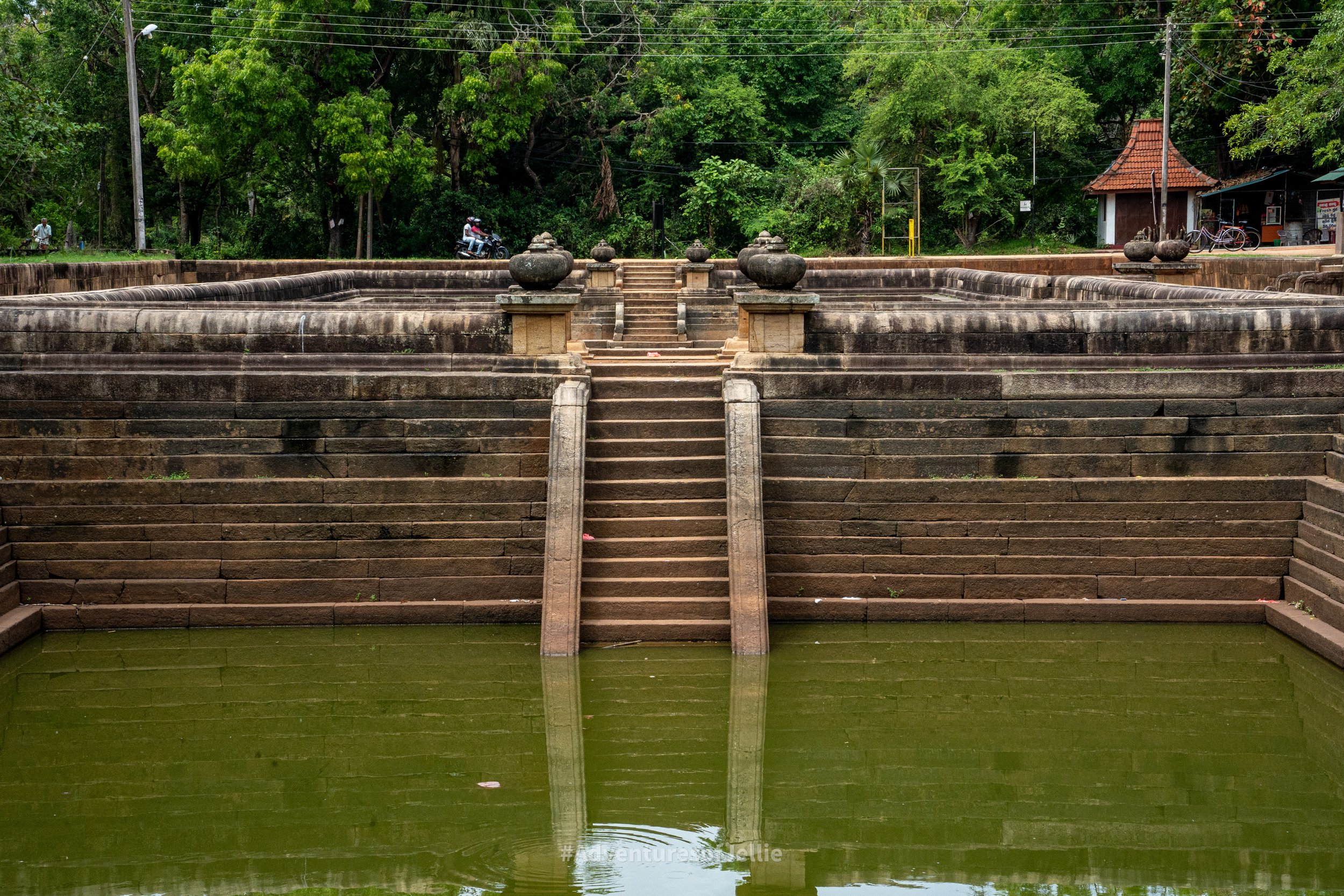
One of the ‘Twin ponds’ - We couldn’t fit them both into one photograph!


Ellie poses away in front of a massive stone doorway.

If you’re found this blog helpful, entertaining or you just fancy supporting us, please click the button below!
If you’ve enjoyed reading this article, why not save the pin below?